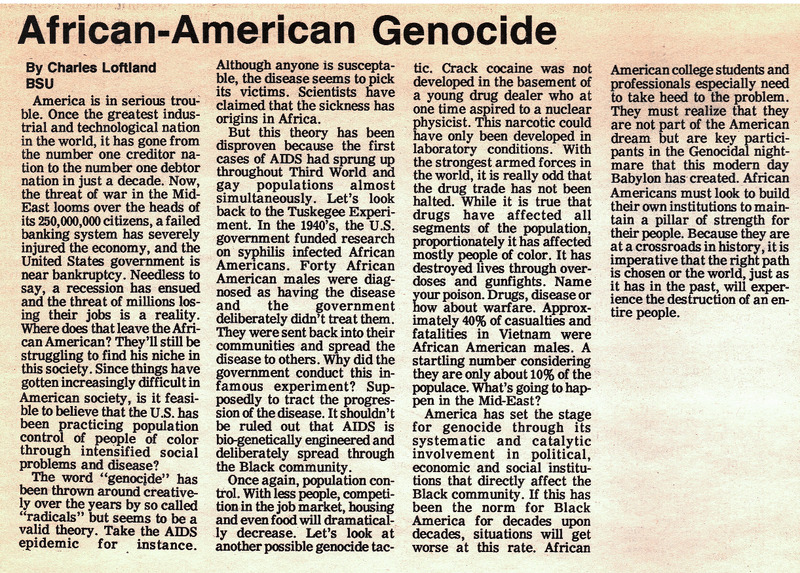
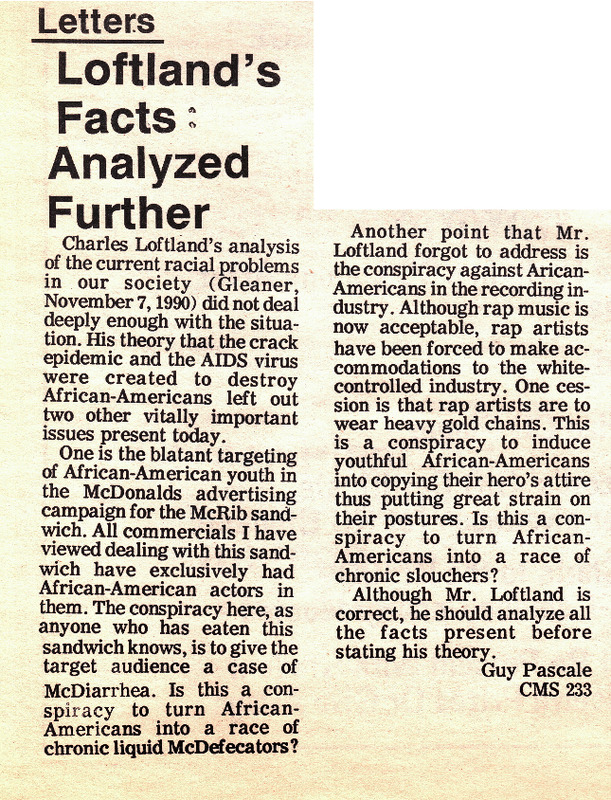
This article critiques the United States for the treatment of African Americans and believes it amounts to genocide. Charles Loftland describes when the government allowed Tuskegee men to spread syphilis in their communities for research purposes and suggests that AIDS may have been similarly engineered. He also discusses the rise in crack cocaine in African American communities. The byline identifies Loftland as a member of BSU (Black Student Union).
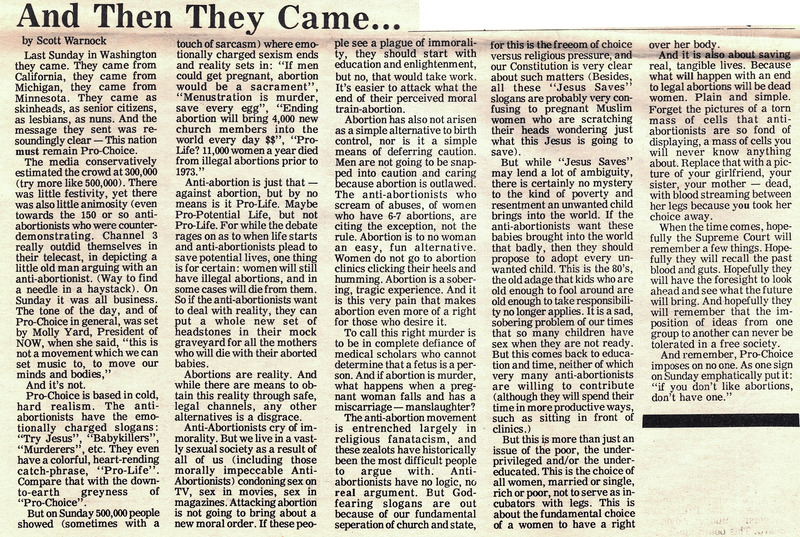
Warnock discusses abortion and argues that the pro-life movement is entrenched in religion and is not realistic. He argues for access to abortion to save women's lives and recognizes that it is a difficult decision for women.
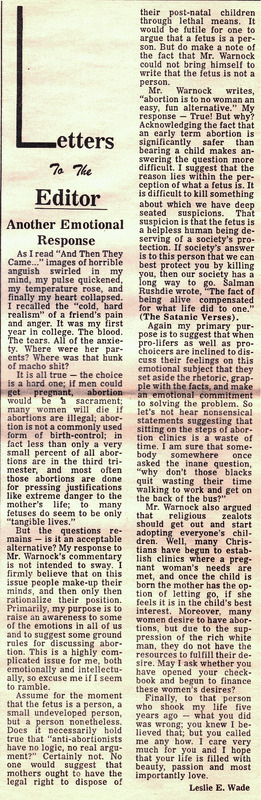
This letter from Leslie E. Wade discusses the issue of abortion and is in response to a previous article published in The Gleaner, "And Then They Came..." Wade reflects on the emotional and intellectual complexity of the issue.
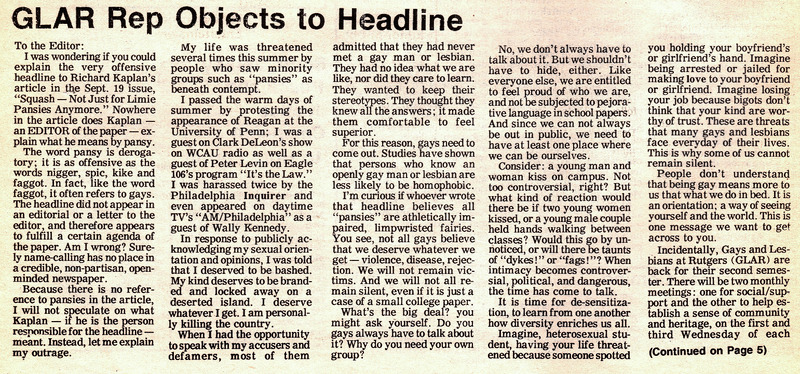
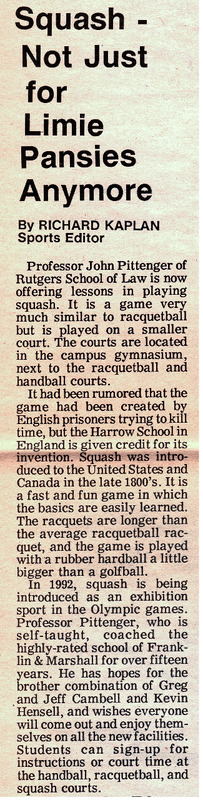
Letter to the Editor about Richard Kaplan's use of the word "Pansies" in the previous publication. The writer, Scott Mallinger, criticizes the usage of the term as homophobic and offensive against the LGBTQ community. He promoted the student organization, Gays and Lesbians at Rutgers (GLAR) as well. Mallinger's letter is followed by a brief response from John, a gay correspondent at the Gleaner, who argues that Mallinger needs to "loosen up" and that the use of "pansy" in a headline is different from the hateful use of slurs.
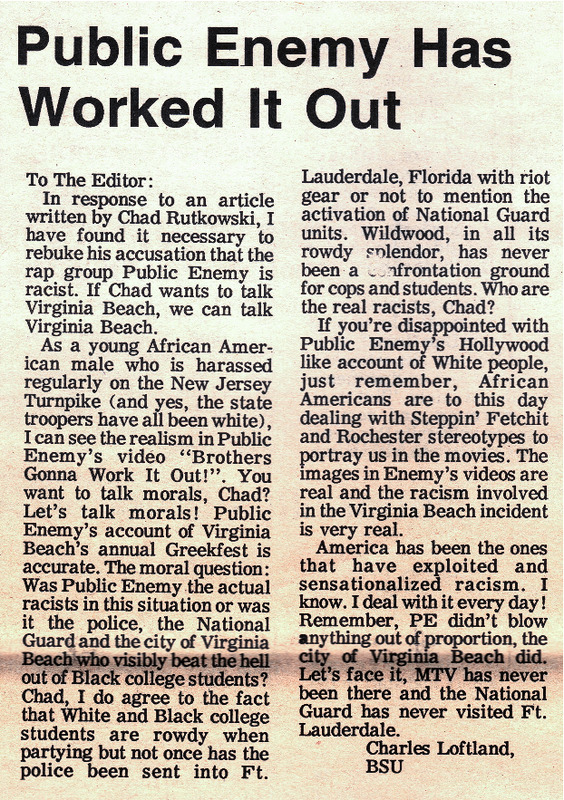
This Letter to the Editor responds to a previous article about Public Enemy. Loftland points to his own experiences of racism and prejudice as proof of Public Enemy's realism. Charles Loftland emphasizes that African Americans experience racism and stereotypes in media and popular culture everyday. The byline identifies Loftland as a member of BSU (Black Student Union).
This "Letter to the Editor" responds to a previous article about Public Enemy. Loftland points to his own experiences of racism and prejudice as proof of Public Enemy's realism. Loftland emphasizes that African Americans experience racism and stereotypes in media and popular culture everyday.
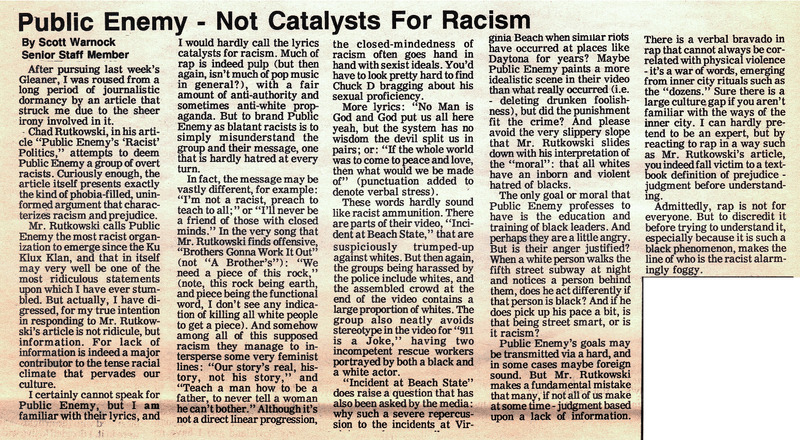
The article is a response to a previous article regarding the rap group Public Enemy. Warnock strongly disagrees with the Rutkowski's critiques that Public Enemy is racist and analyzes several sets of lyrics to prove his point. Warnock views Rutkowski's opinions as a sign of his own racism against black people.
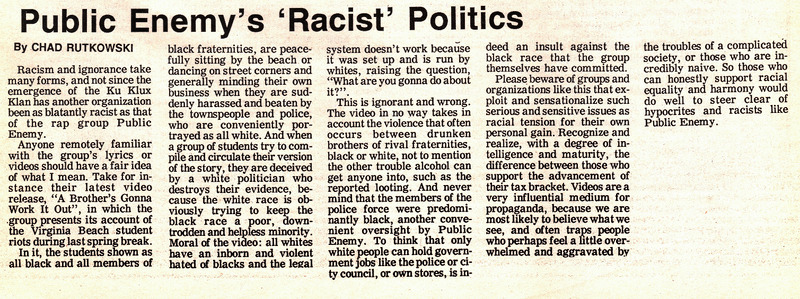
This article describes the rap group Public Enemy as extremely racist and comparable to the Ku Klux Klan. Rutkowski argues that their music video and lyrics portray white Americans incorrectly as entirely immoral and anti-black.
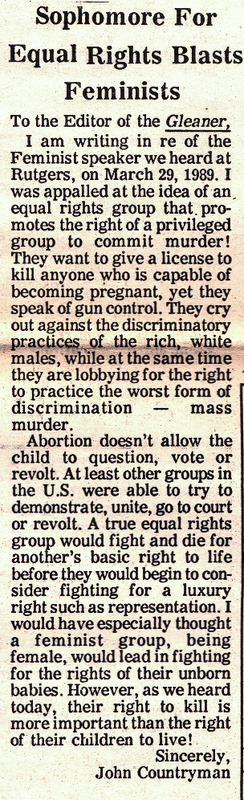
In this letter to the editor, John Countryman strongly criticizes a feminist speaker who visited campus and rebukes the pro-choice arguments of feminist groups.
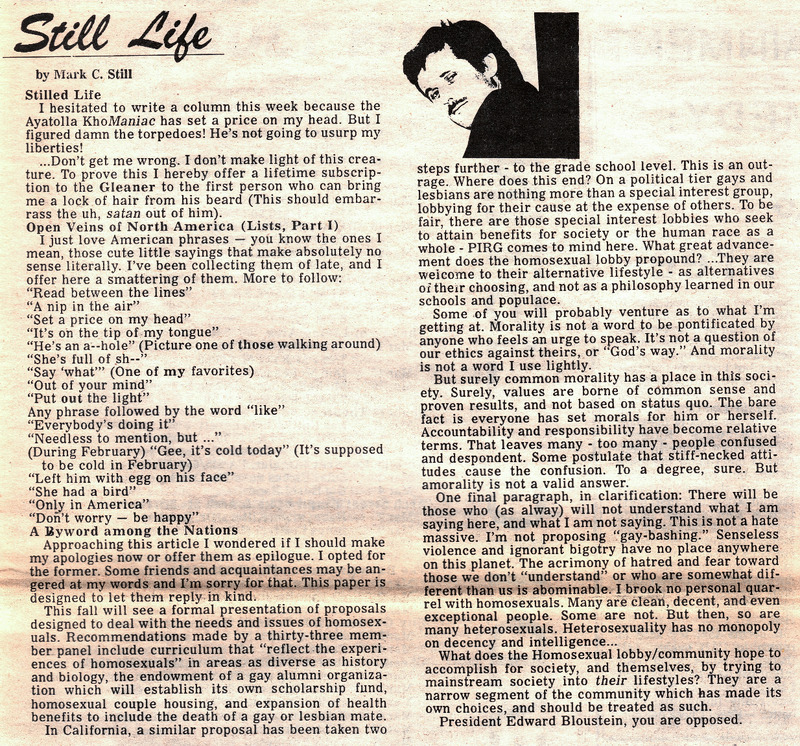
Article about the different legislation pushed by LGBTQ activists. He does not wish to enact harm on the community, but questions their motives and emphasizes the importance of morality.
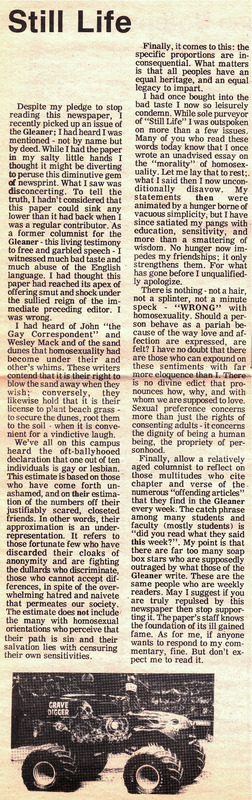
Though Mark C. Still is not directly listed as the author, based on the writing it is insinuated that Still wrote this piece. Still condemns the homophobia present in the Gleaner and on campus, going so far as to apologize for a previous article in which he described the morality of homosexuality. He also states that for those who are upset with the Gleaner, they should simply stop reading rather than complain and critique.
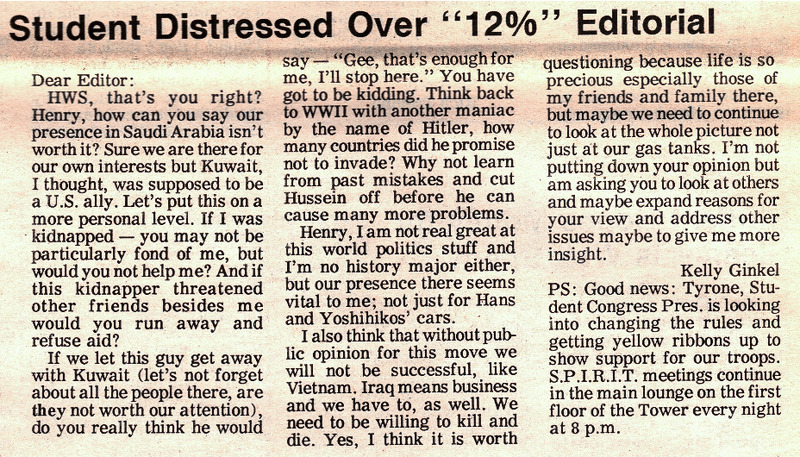
This "Letter to the Editor" is in response to the Gleaner's articles on Saudi Arabia and Kuwait. The writer believes the United States needs to have a presence in the Middle East and that the Gleaner is disregarding the risks posed by Iraq and Saddam Hussein.
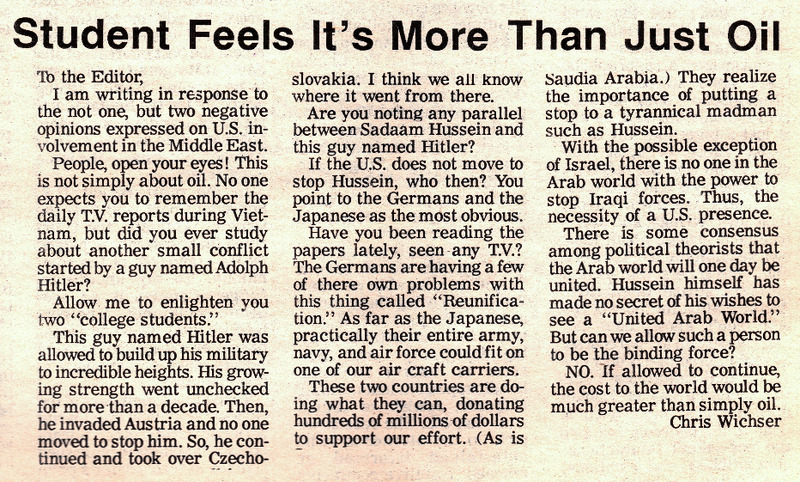
This letter to the Editor sarcastically details the the conflict in the Middle East in response to previous articles published in the Gleaner. He argues that Saddam Hussein's actions mirror those of Hitler and that the conflict can cause issues for more than just oil.
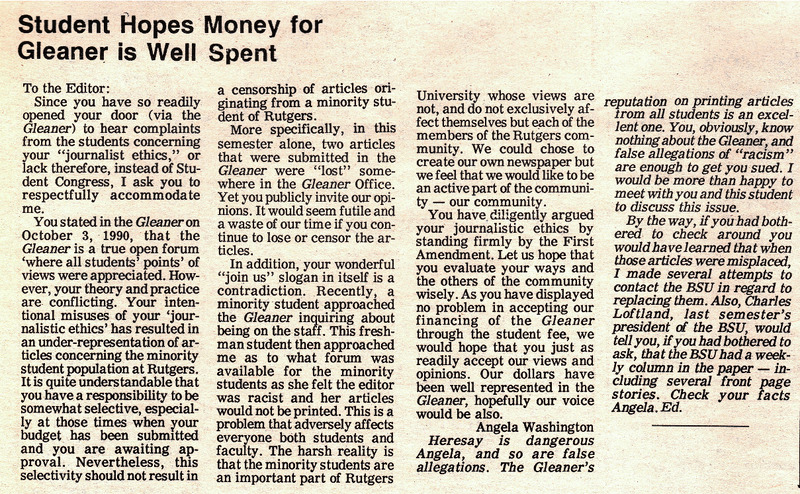
In a letter to the editor, Angela Washington accuses the Gleaner of "journalistic ethics" violations and the censorship of minority students, citing instances where submitted articles were allegedly "lost" or ignored by the staff. An editorial response follows, vehemently denying these claims of racism and mismanagement.
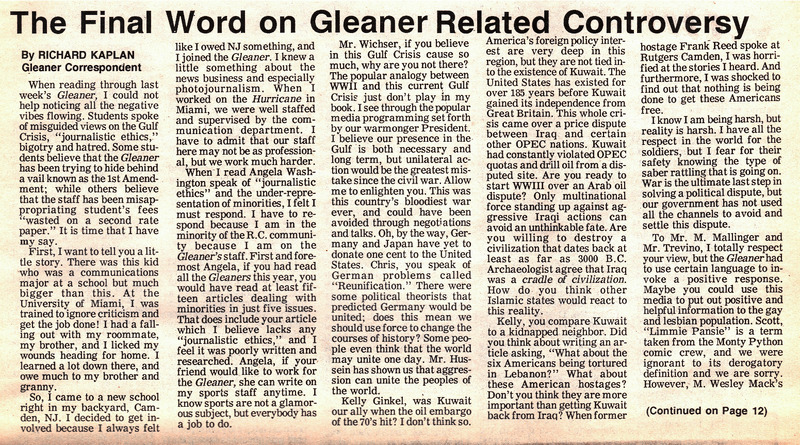
The article is a response to multiple recent "Letters to the Editor." Richard Kaplan criticizes each writer and their complaints, arguing that the Gleaner staff diligently put together the newspaper every week and deserve more respect for their efforts.
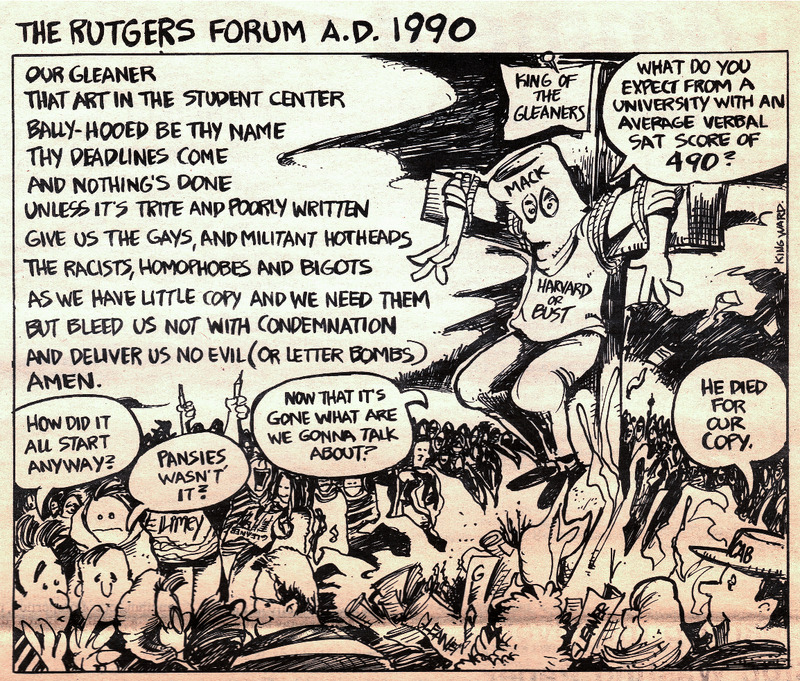
This satirical cartoon and poem mock the recent controversies surrounding the Gleaner. The cartoon depicts Michael Mack, Executive Editor of the Gleaner, being burned at the stake by critics of the student newspaper. The crowd struggles to remember why he is being executed, while Mack questions the intelligence of the Rutgers-Camden student body.
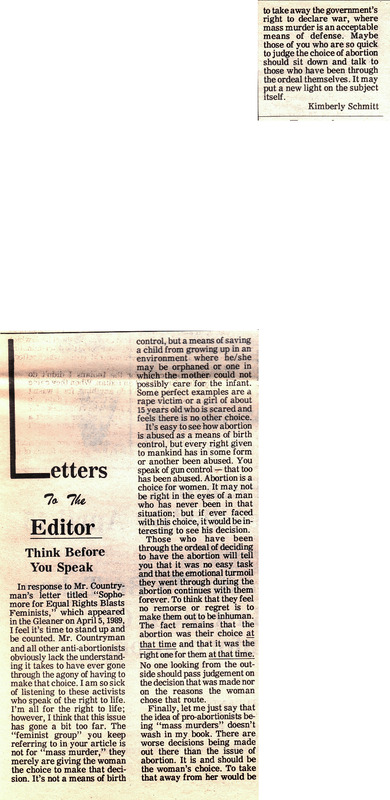
This letter responds to a previously published letter from Mr. Countryman about abortion. Schmitt is pro-choice and refutes Mr. Countryman's arguments.
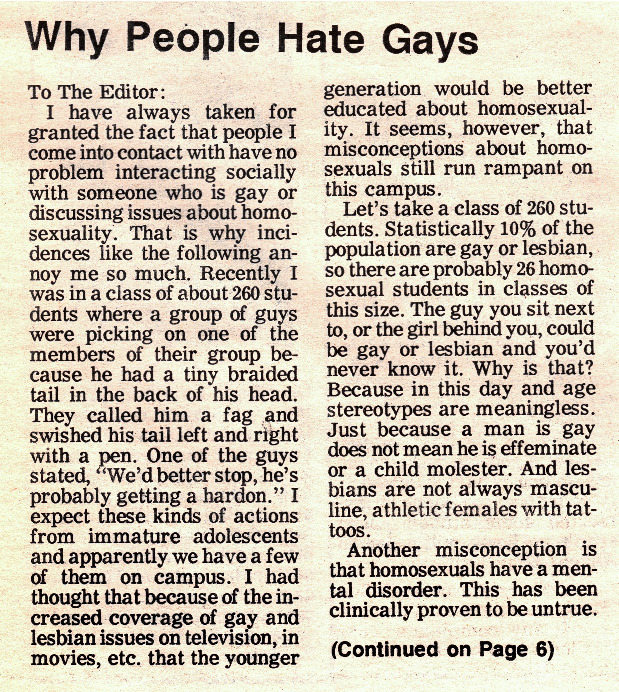
In a letter to the editor titled "Why People Hate Gays," Rich Trevino addresses the persistence of homophobia on the Rutgers–Camden campus. Trevino critiques the Gleaner for its "irresponsible" use of language, specifically referencing the recent "pansy" headline.