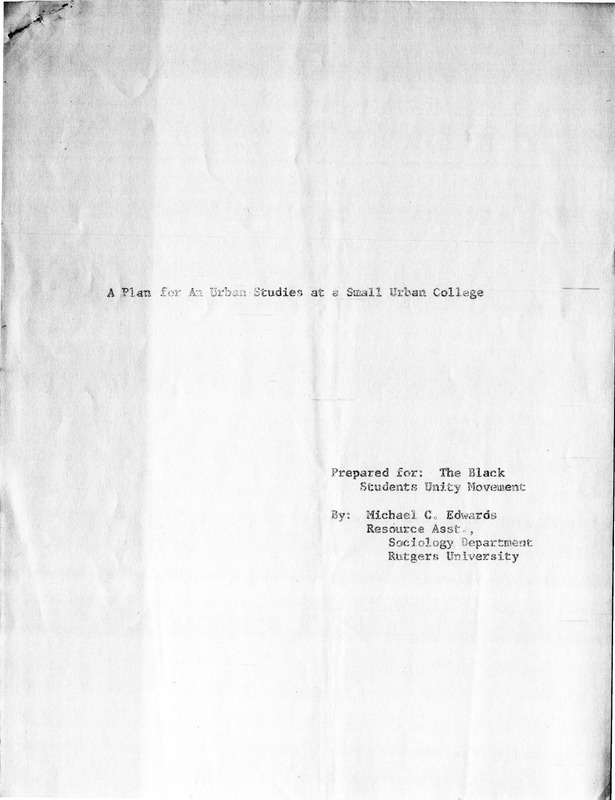
A proposal for creating an Urban Studies program at the College of South Jersey (Rutgers-Camden), prepared for the Black Student Unity Movement by Malik Chaka (Michael C. Edwards), Resource Assistant at the Sociology Department. Chaka was a Rutgers–Camden student and a member of the Black Student Unity Movement (BSUM). This document outlines an interdisciplinary curriculum focused on the scholarly study of urban affairs, politics, and sociology. This proposal served as the blueprint for what would eventually become the formal Urban Studies program at Rutgers–Camden.
Urban Studies is not to be confused with the Urban University Department (UUD), which was a support initiative for student access that also grew out of black student activism at Rutgers in 1969.
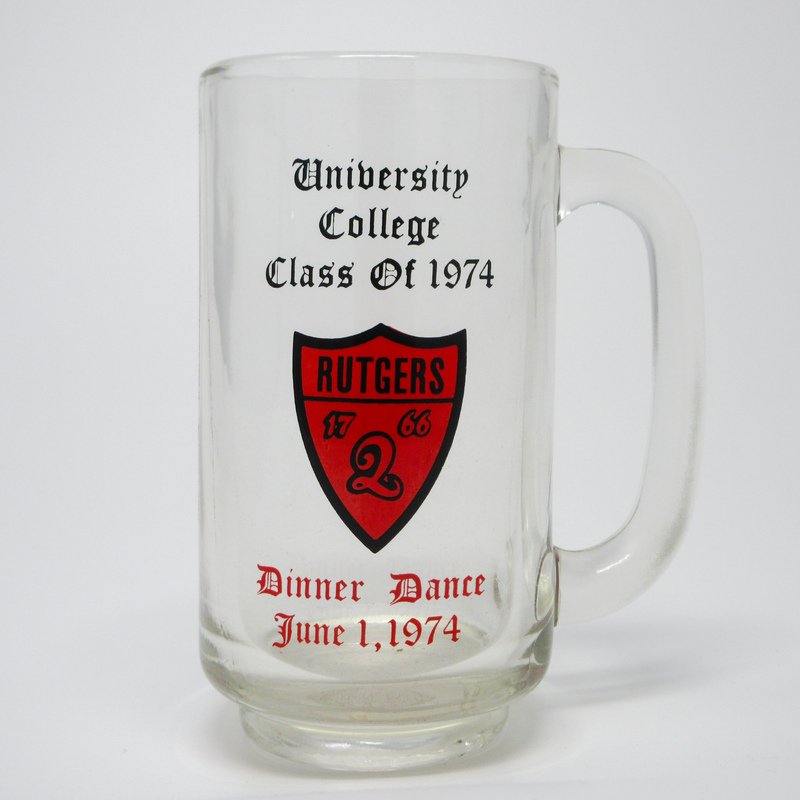
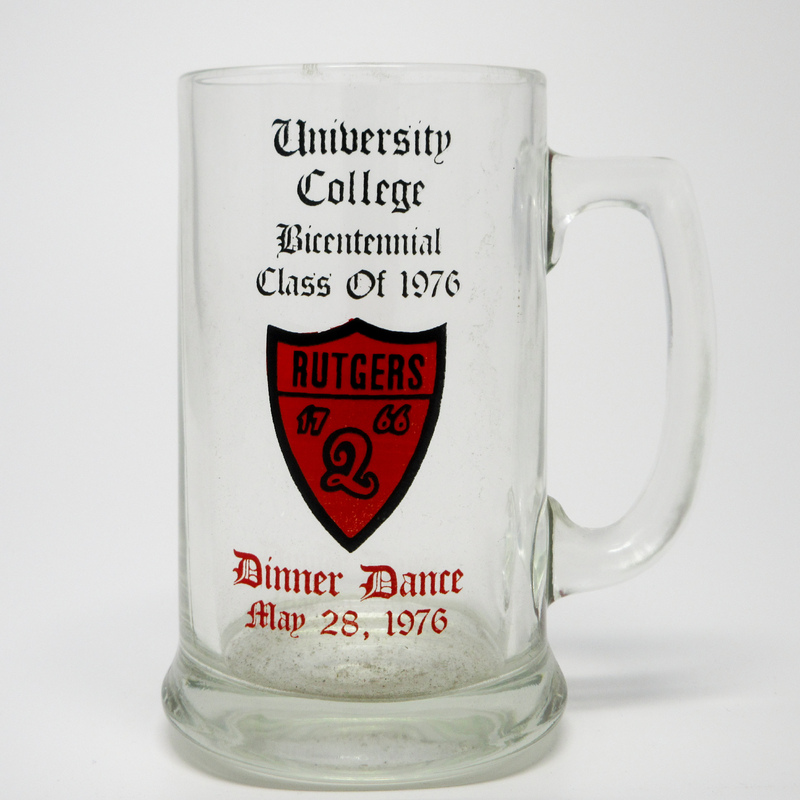
Glass beer stein with black engraving on top of "University College Class of 1974". Underneath it is Rutgers shield emblem with engravings "Rutgers 17 2 66". Underneath in black engraving is "Dinner Dance June 1, 1974".
Glass beer stein with black engraving on top of "University College Class of 1974". Underneath it is Rutgers shield emblem with engravings "Rutgers 17 2 66". Underneath in black engraving is "Dinner Dance May 28, 1976".
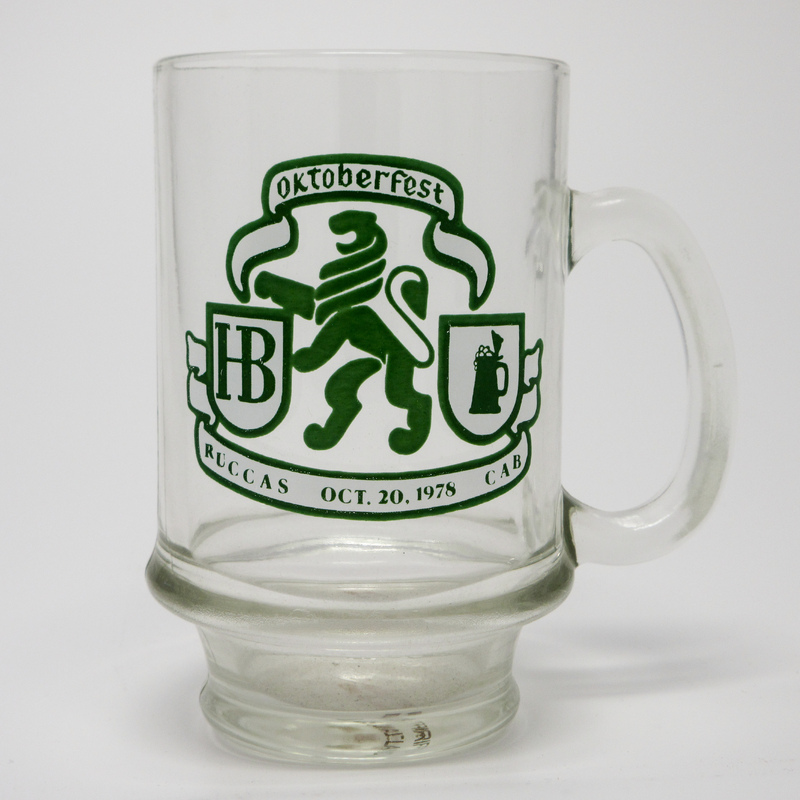
Glass beer stein with green and white crest of a lion with a shield engraved with "HB" and nother shield with a beer stein. At bottom of crest of several inscrptions "RUCCAS", "OCT20.1978" and "CAB". Item is embossed with producer label on bottom "Griffith Pottery Iteland, PA. 19075"
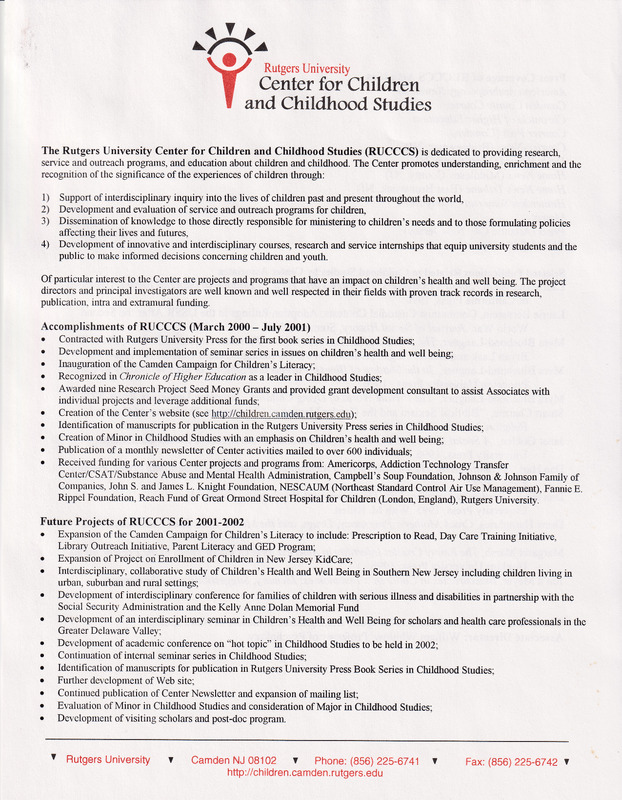
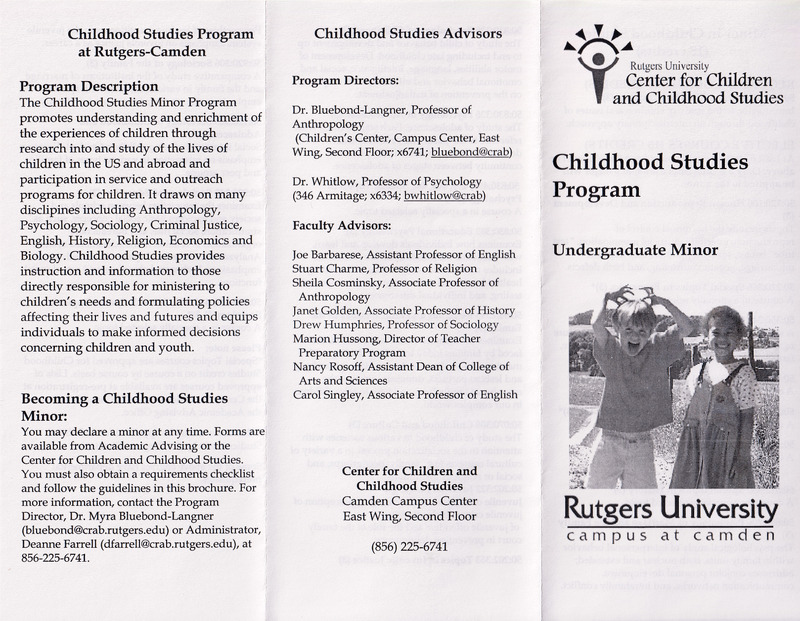
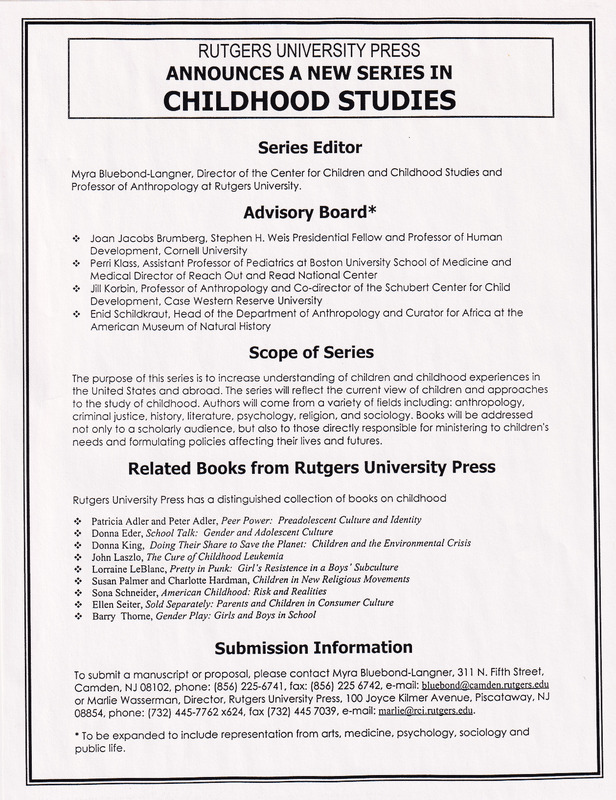
Childhood Studies Program Undergraduate Minor brochure outlining program requirements. The brochure is undated, but is filed with the program's earliest documents and is presumed to be from the academic year 2000-2001, representing the original requirements at the time of the program's inception.
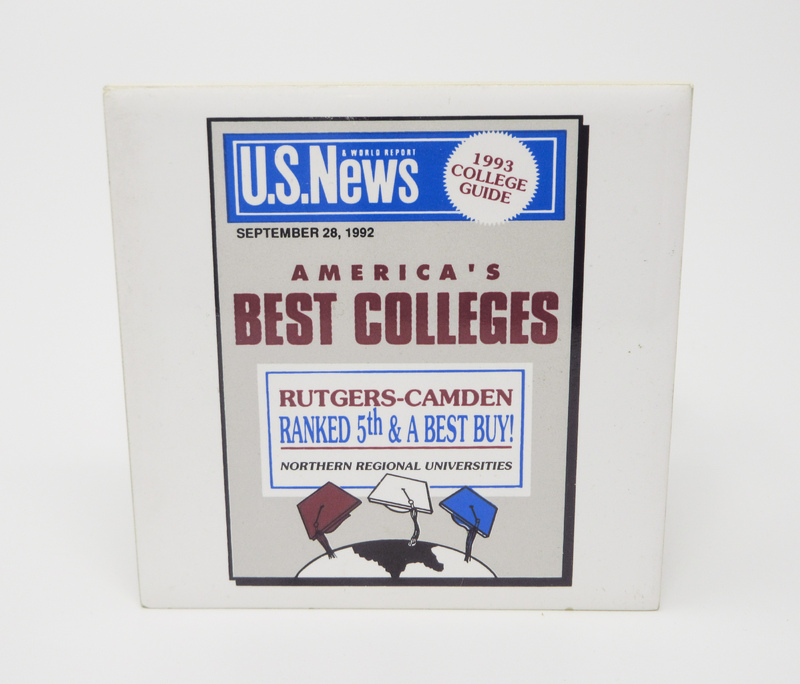
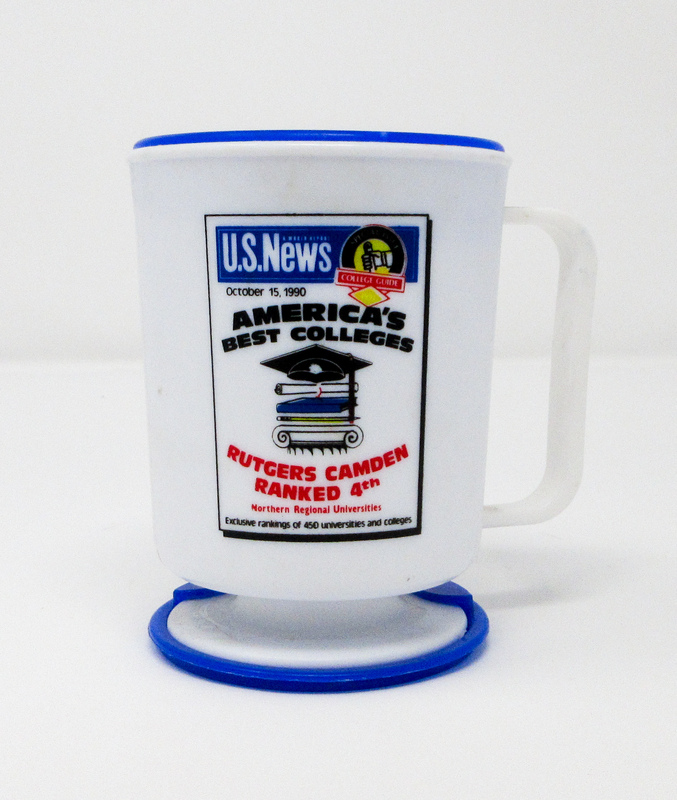
White ceramic coaster celebrating rankings from U.S. News and World Reports. Text reads "U.S. News and World Reports; 1993 College Guide; September 28, 1992; America's Best Colleges; Rutgers-Camden Ranked 5th & A Best Buy! Northern Regional Universities"
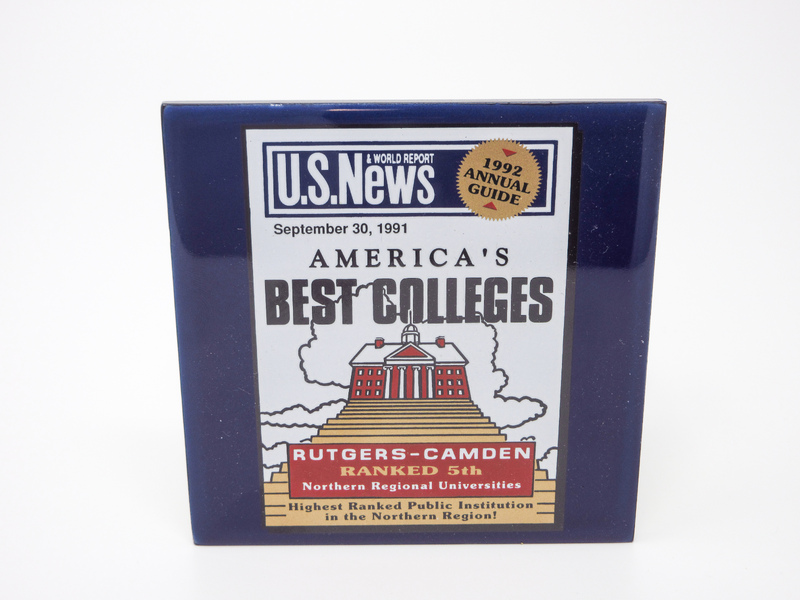
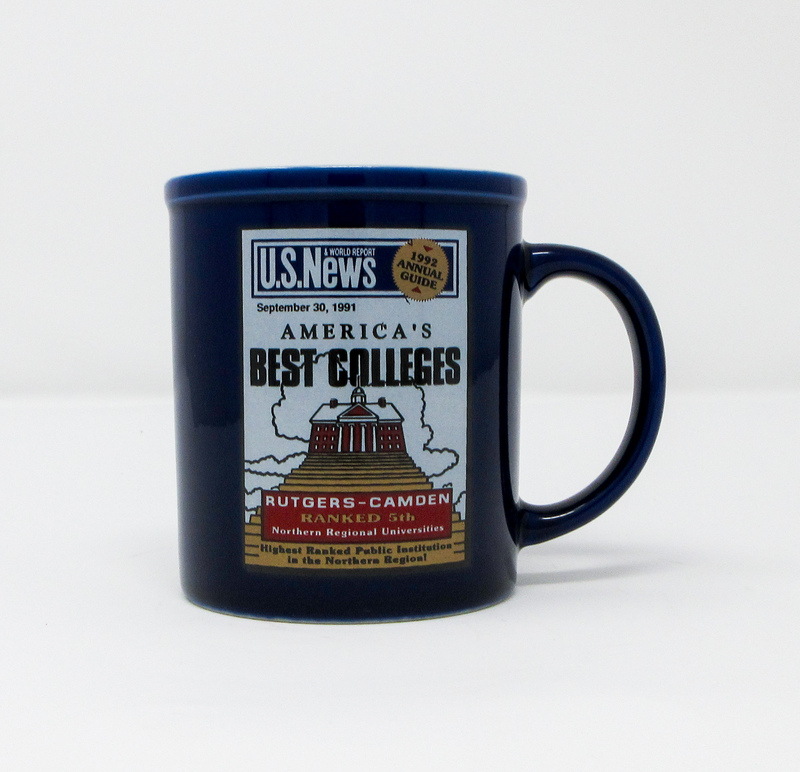
Blue ceramic coaster celebrating rankings from U.S. News and World Reports. Text reads "U.S. News and World Reports; 1992 College Guide; September 30, 1991; America's Best Colleges; Rutgers-Camden Ranked 5th Northern Regional Universities; Highest Ranked Public Institution in the Northern Region"
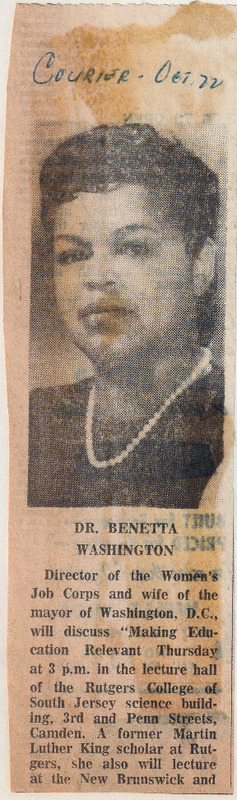
Dr. Benetta Washington, director of the Women's Job Corps, gives a lecture on "Making Education Relevant" at Rutgers-Camden. A photograph of Dr. Washington accompanies the short news item.
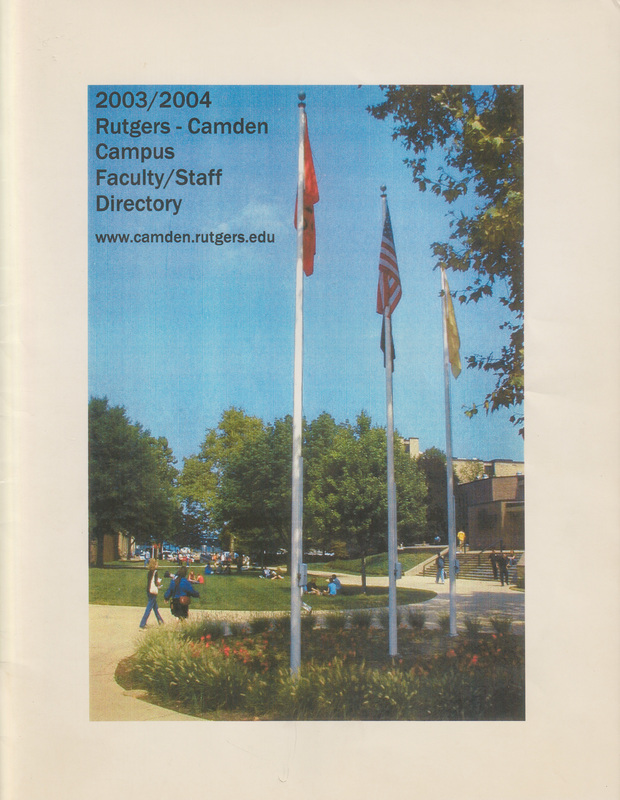
Cover of the 2003/2004 Rutgers-Camden Campus Faculty/Staff Directory, featuring a photograph of the Quad in springtime with students milling about. The view faces northward, with flagpoles in the foreground and the Paul Robeson Library seen on the right side.
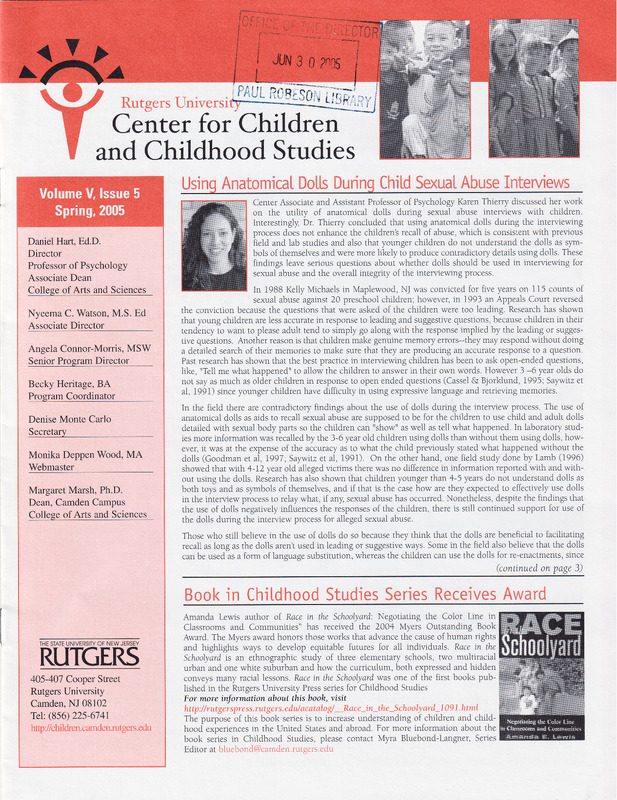
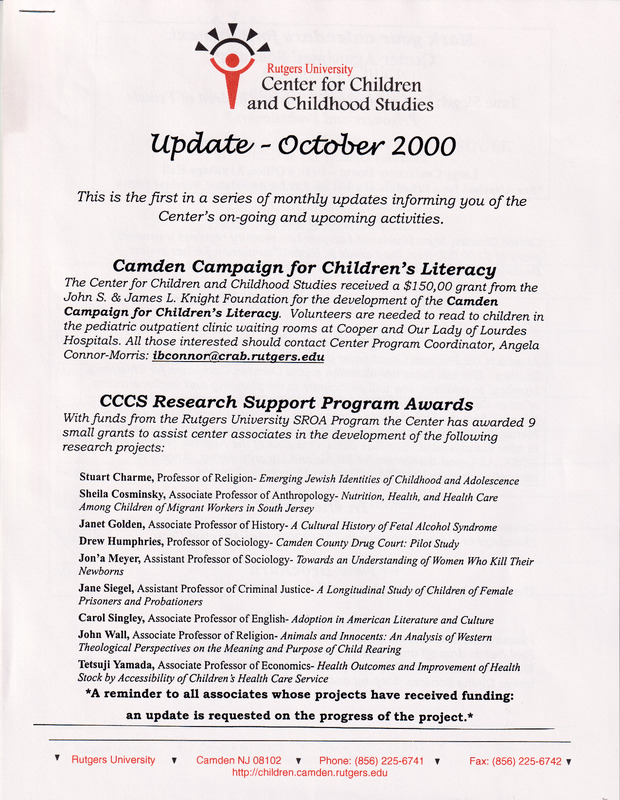
A scan of page 17 has been included here as an illustration for a student project related to the Childhood Studies program. This page provides a snapshot of the Center for Childhood Studies in 2003/2004, featuring key staff and faculty, their roles, and campus location.
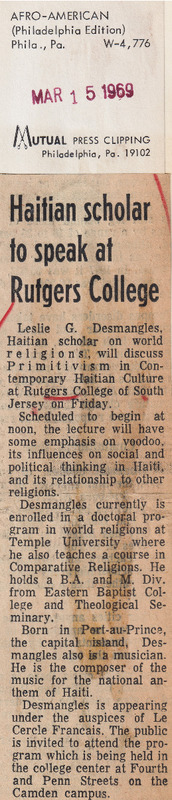
Leslie G. Desmangles, a professor at Temple University, is set to lecture about world faiths, specifically voodoo and its influence on Haiti, at Rutgers.
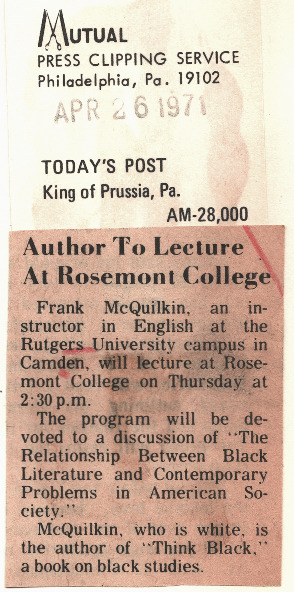
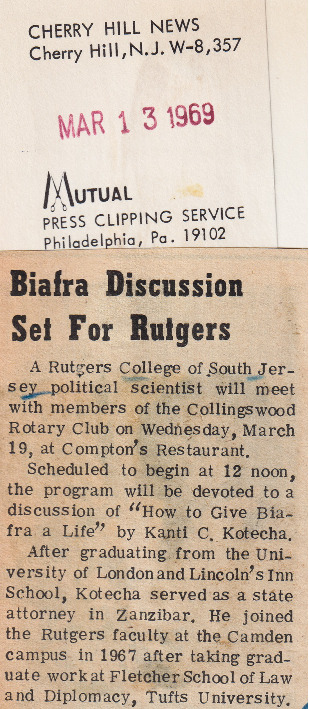
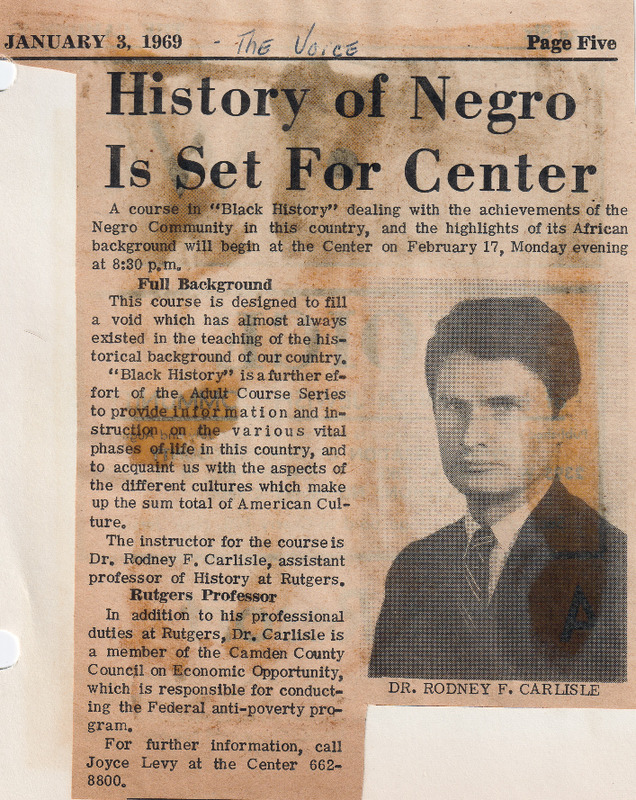
A series of lectures on Black History are advertised for the upcoming February, being held at the Jewish Community Center in Cherry Hill. The lecturer, a Rutgers professor, is also a member of the community center, and the lecture's aim is to bring attention to the little-known history of African Americans.
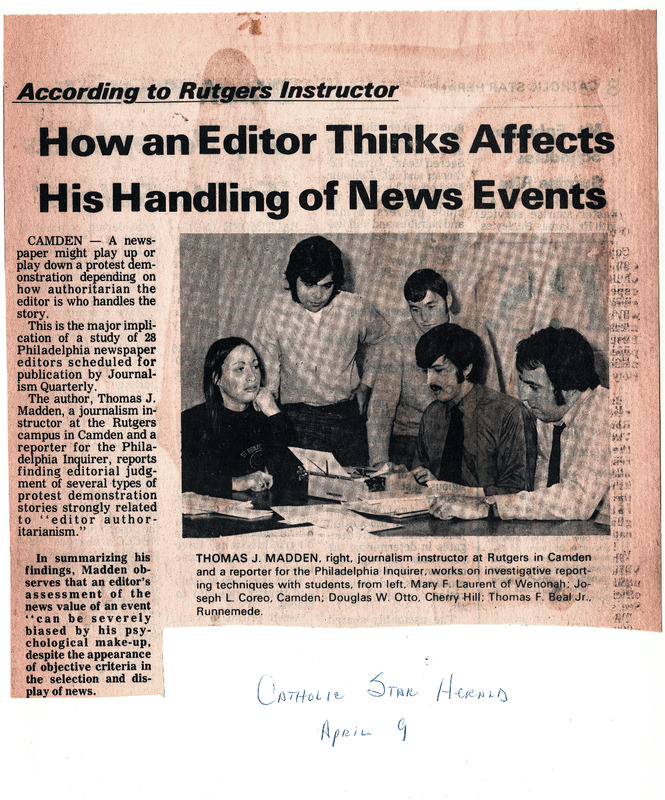
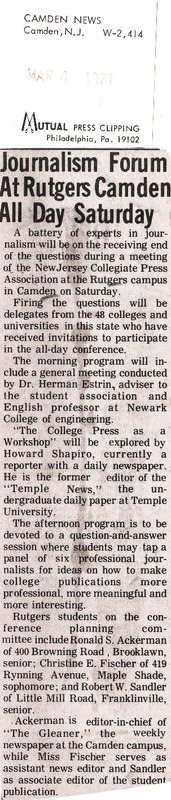
Article highlighting a research study of political bias in the press led by Thomas J. Madden, a Rutgers-Camden journalism professor and Philadelphia Inquirer reporter.
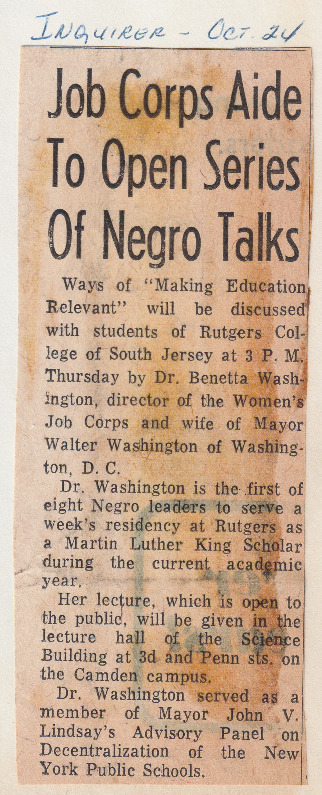
Dr. Benetta Washington, director of the Women's Job Corps, gives a lecture on "Making Education Relevant" in the Rutgers science building. She will be the first in a series of Black leaders giving lectures at Rutgers as part of the Martin Luther King Scholar series.
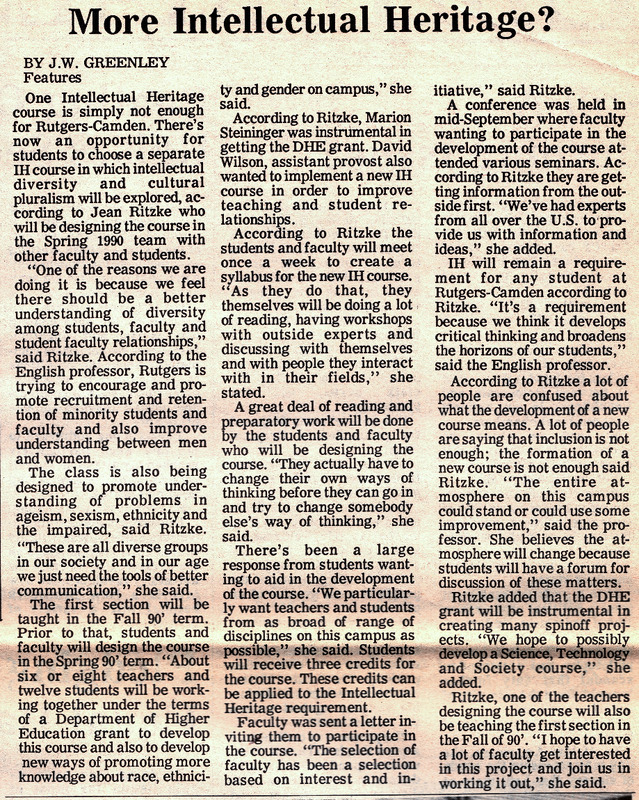
This article discusses the development of a new Intellectual Heritage (IH) course at Rutgers–Camden designed to explore intellectual diversity and cultural pluralism. Jean Ritzke, the English professor developing the course, is quoted extensively throughout the article.
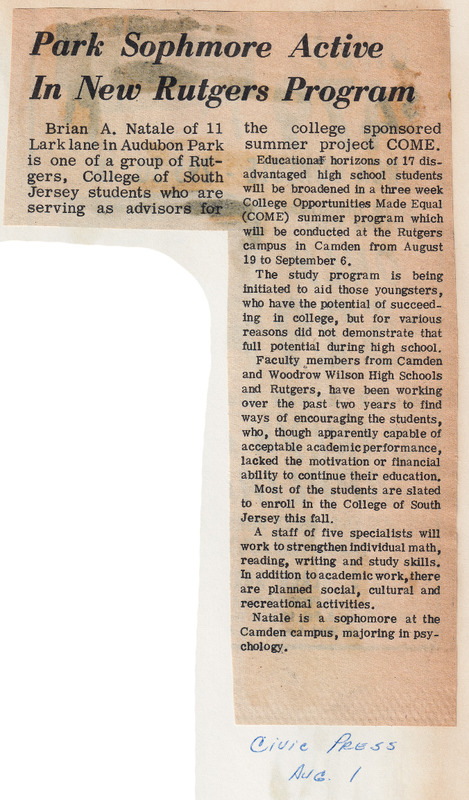
The new program, College Opportunities Made Equal (COME), is beginning in the coming summer, with a three-week program for disadvantaged students who will soon be attending Rutgers even despite lack of finances or motivation to continue. The program will have specialists who train the students in study skills as well as core subjects, as well as social programs.
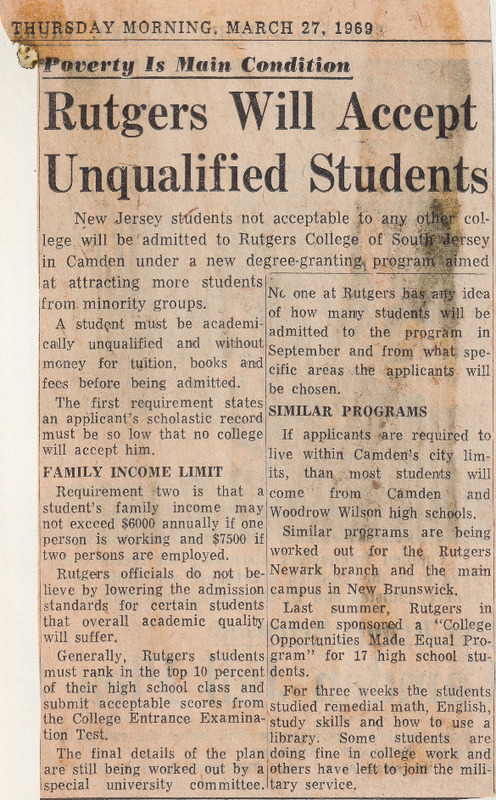
This article writes derisively about the new program for accepting disadvantaged students, despite noting that "Rutgers officials do not believe... that overall academic quality will suffer" and that the COME program from the previous summer was highly successful.
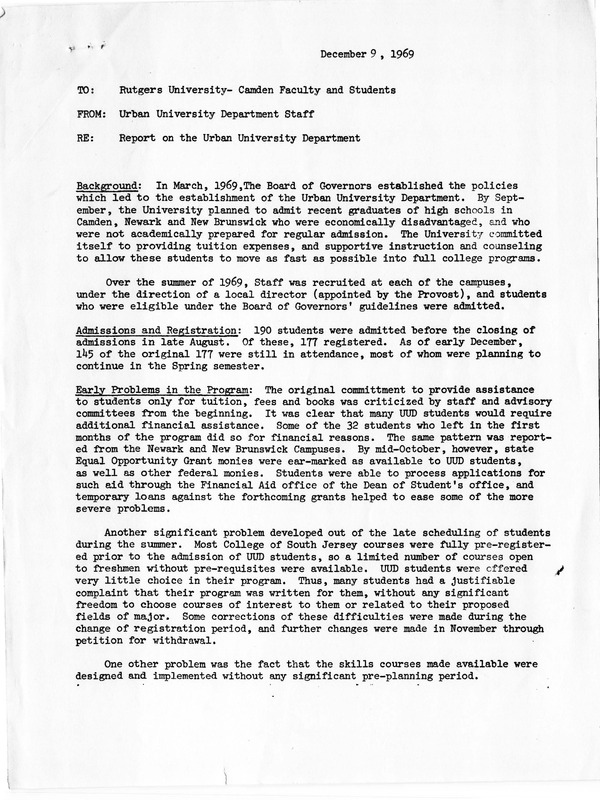
Two-page report from the Urban University Department (UUD) staff regarding the department's problems and progress since the program's inception at Rutgers–Camden in March of 1969. The report mentions the constructive criticism provided by the Black Student Unity Movement (BSUM) during UUD's early development.
UUD was an administrative and support initiative focused on college access, providing financial aid, remedial "skills" courses, and counseling for disadvantaged students. This program functioned as a support service to help students transition into the university and eventually evolved into the Educational Opportunity Fund (EOF) and academic foundation structures for student success.
UUD is not to be confused with the Urban Studies curricular program that also grew out of BSUM activism on campus.
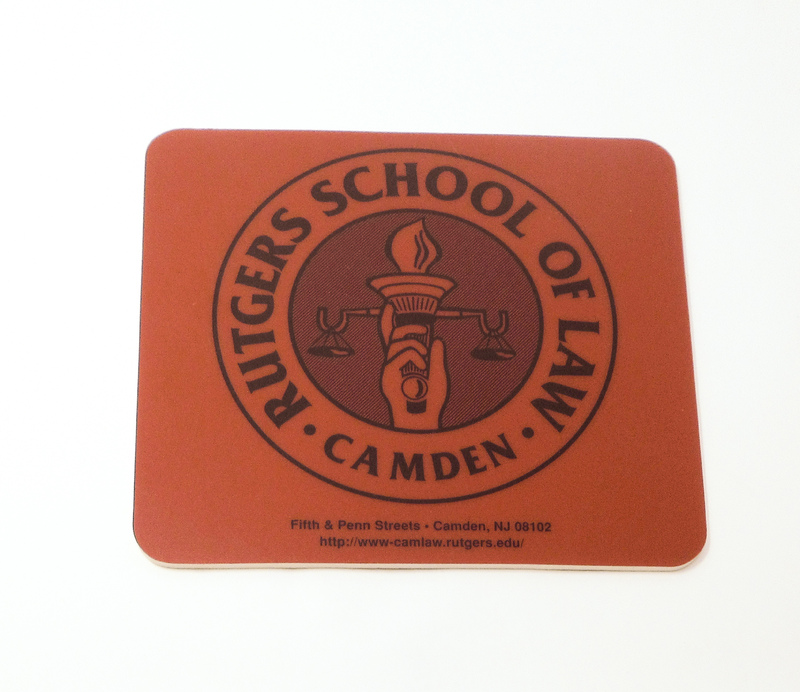
Red mouse pad with the the Rutgers School of Law Camden logo in the center. Printing on the botton read "Fifth & Penn Streets • Camden, NJ 08102
http://www-camlaw.rutgers.edu/"
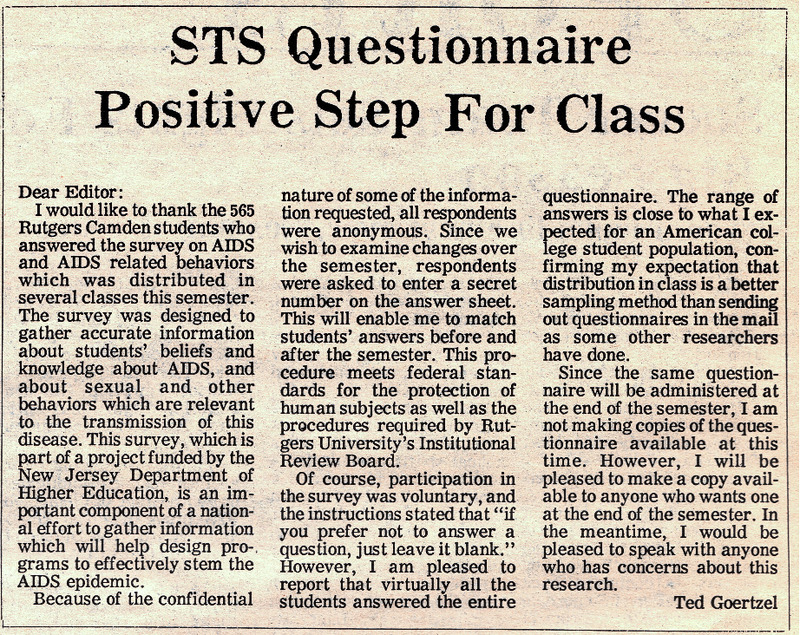
In a letter to the editor, Ted Goertzel (sociology professor) responds to concerns regarding the sexual behavior survey distributed in the Science, Technology and Society (STS) course. He explains that the survey is part of a project funded by the New Jersey Department of Higher Education aimed at gathering data to design programs to combat the AIDS epidemic. Goertzel defends the methodology, noting that the survey was voluntary, anonymous, and met federal and university standards for the protection of human subjects.
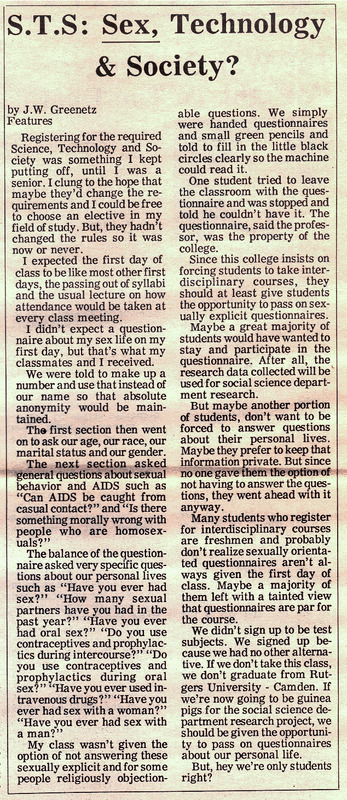
Greenetz writes about a questionnaire about AIDS, sex, and contraceptives given in their Science, Technology, and Society course. The piece denounces that the questionnaire was "forced" and too personal.
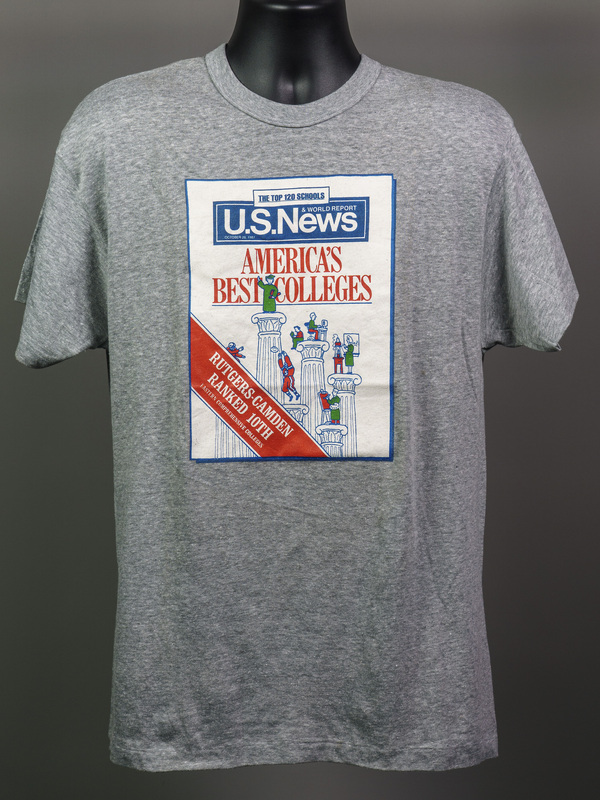
A gray t-shirt with an image of a U.S News and World Report cover. The cover shows columns of various hieghts with students playing football, painting, conducting science experiments, reading, working on a comupter, and graduating. At the bottom right of the image reads "Rutgers-Camden ranked 10th, Eastern Comprensive Colleges."
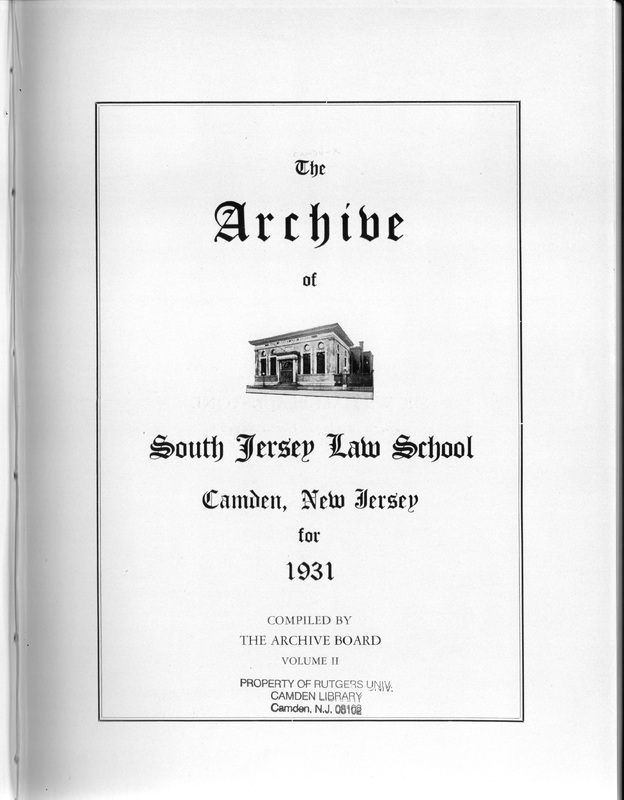
Rutgers University–Camden has its roots in the South Jersey Law School, which was founded in 1926. The law school's original yearbook was called "The Archive." The first volume of the yearbook (The Archive 1930) is not available at Special Collections, and it is unknown whether a copy of it still exists in any private collection. Volume 2, for the year 1931, is the oldest yearbook that we currently have in Special Collections. A list of 1930 graduates who were admitted to the bar after graduation was included in the 1931 yearbook.
The library copy of The Archive 1931 is missing a portion of page 24. This page shows portraits of the school's administration. It appears that a portrait in the center of page 24 was cut out creating a neat rectangular hole in the page.