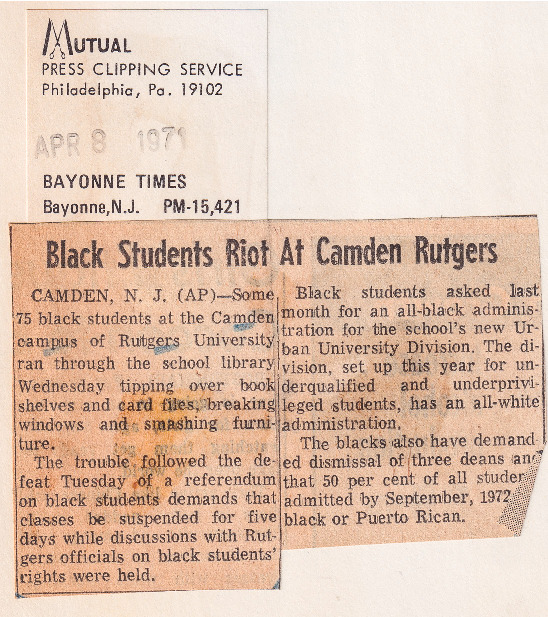
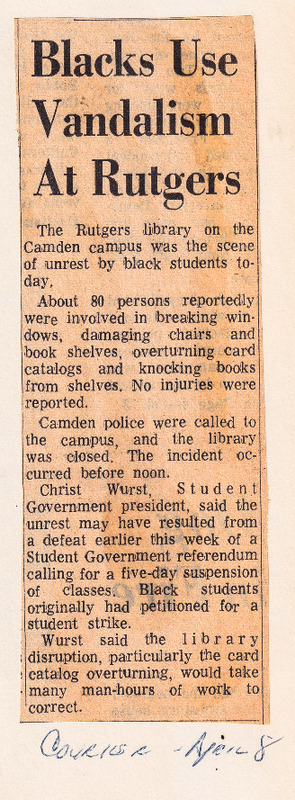
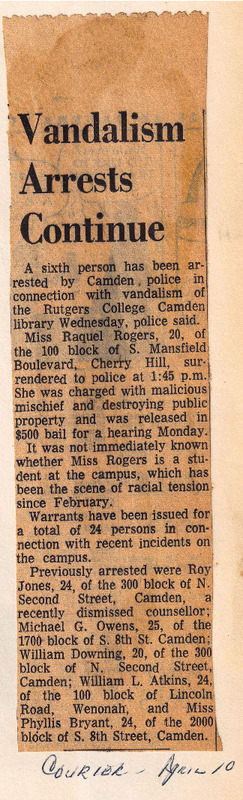
This article discusses the vandalism charges against the specific individuals who were involved in the library protest. They include specific names of the indivudials involved.
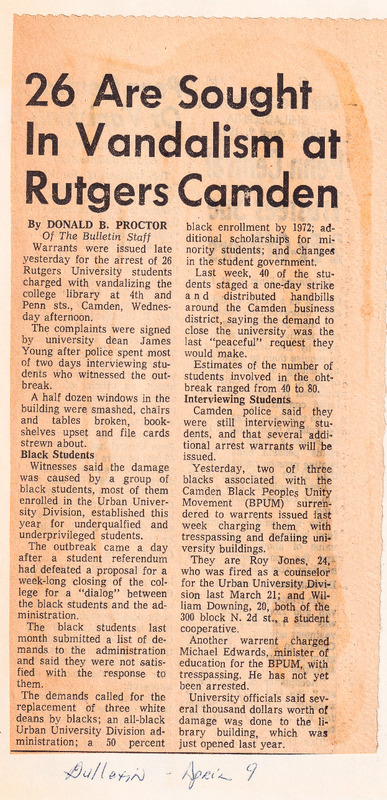
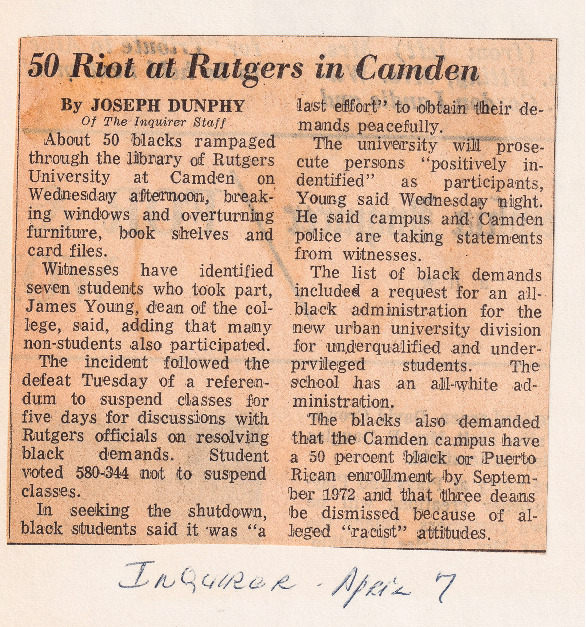
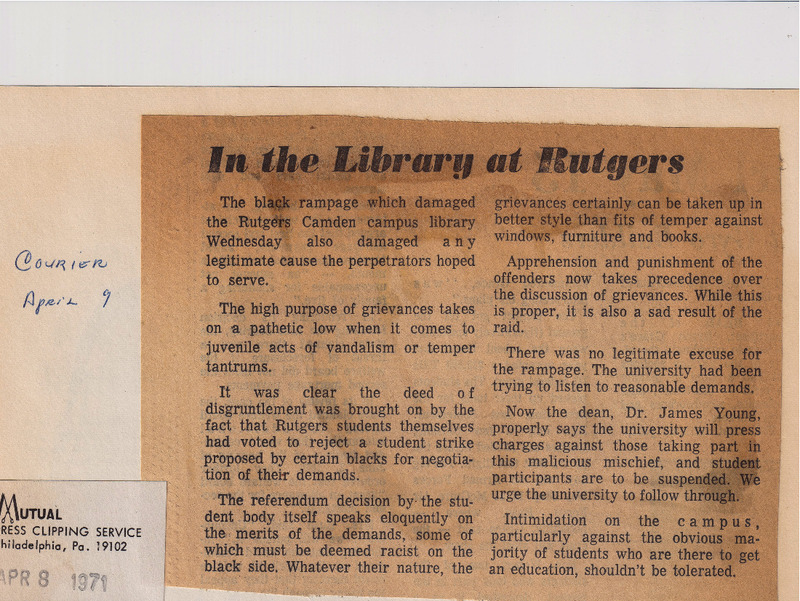
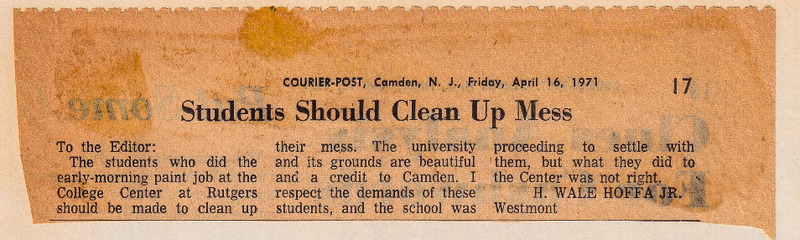
Author takes a hardline stance against the actions of Black students who protested the selection of an all-white administran for the Urban University Division by damaging parts of the library.
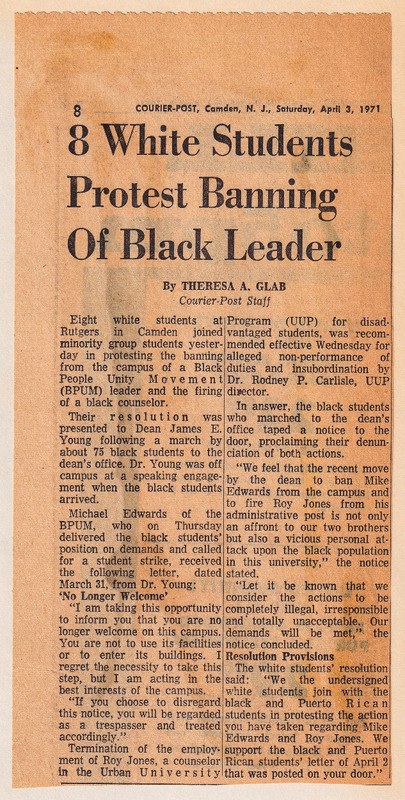
Describes the banning of a Black Student Unity Movement (BSUM) leader. In response a multiracial coalition of students , including 8 White students protest.
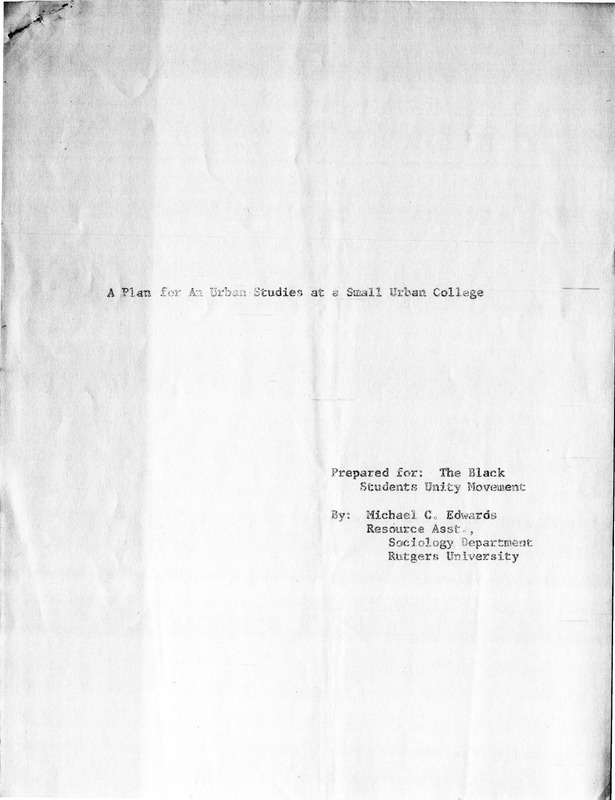
A proposal for creating an Urban Studies program at the College of South Jersey (Rutgers-Camden), prepared for the Black Student Unity Movement by Malik Chaka (Michael C. Edwards), Resource Assistant at the Sociology Department. Chaka was a Rutgers–Camden student and a member of the Black Student Unity Movement (BSUM). This document outlines an interdisciplinary curriculum focused on the scholarly study of urban affairs, politics, and sociology. This proposal served as the blueprint for what would eventually become the formal Urban Studies program at Rutgers–Camden.
Urban Studies is not to be confused with the Urban University Department (UUD), which was a support initiative for student access that also grew out of black student activism at Rutgers in 1969.
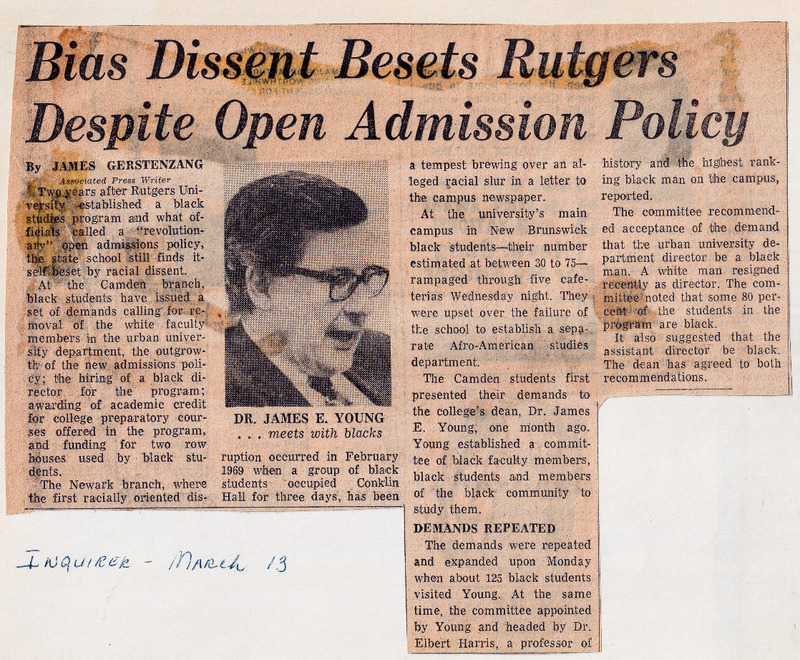
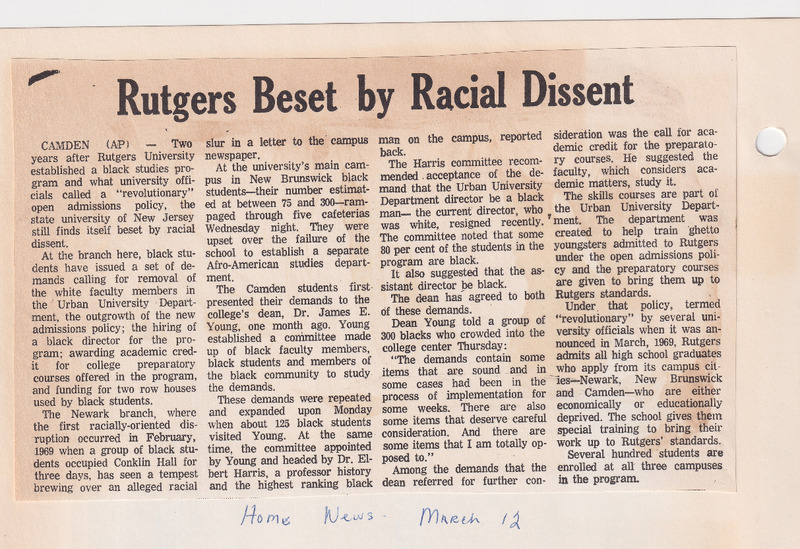
Black Students at Rutgers are still fighting for representation at Rutgers in a multitude of areas, despite Rutgers introducing a "revolutionary" open admissions policy.
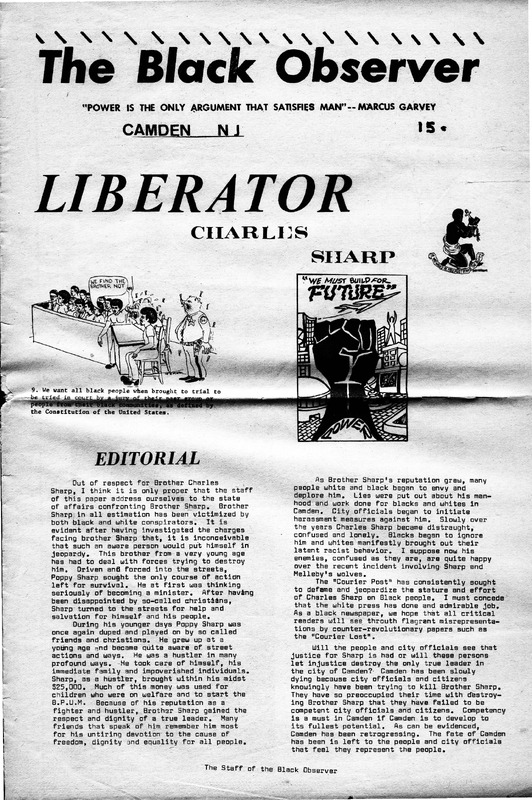
Complete 8-page issue of the Black Observer newsletter from Camden, NJ, circa fall 1969. The precise date is not printed on the issue. Rutgers-Camden students affiliated with the Black Student Unity Movement (BSUM) produced this paper for the community. Names of the editors and contributors printed on the back page are Roy Jones, Marie Spearman, Faye Waters, Myrna Williams, Vince Mayfield, Carolyn Williams, Ralph Spencer, Richard Rhodes, Alice Syms, Linda Ellis, R. Eugene Kirkland, Lillian Matthews, Fredia Bodie, Betty Coleman. A letter from Aaron G. Thompson on behalf of the Rutgers BSUM is printed on page 5.
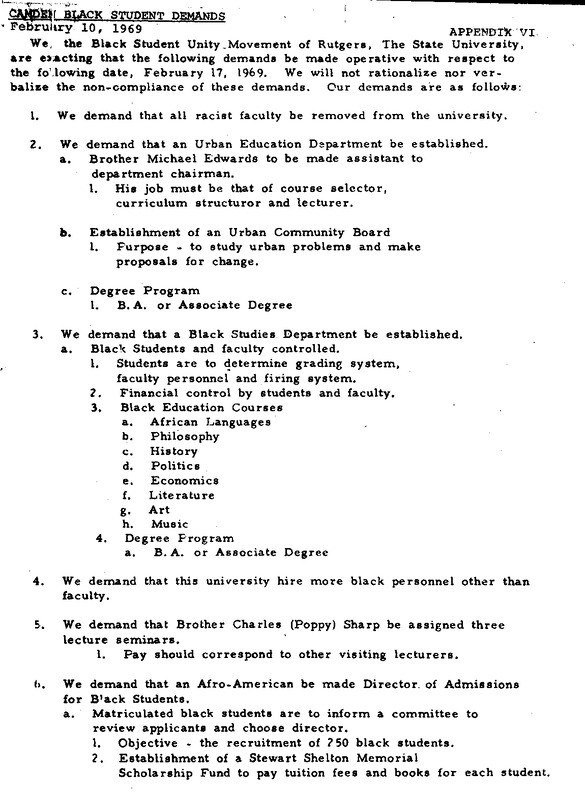
24 demands presented by the Black Student Unity Movement to Rutgers University–Camden on February 10, 1969. The demands were distributed widely on campus, and multiple copies have been preserved in Special Collections at the Paul Robeson Library in Camden and at the Alexander Library in New Brunswick. This copy is from Appendix VI in Ralph A. Dungan's 1969 Report to the New Jersey Legislature Concerning the Recent Events and Disturbances at the Newark and Camden Campuses of Rutgers, the State University.
Author takes a hardline stance against the actions of Black students who protested the selection of an all-white administran for the Urban University Division by damaging parts of the library.
Author takes a hardline stance against the actions of Black students who protested the selection of an all-white administran for the Urban University Division by damaging parts of the library.
Author takes a hardline stance against the actions of Black students who protested the selection of an all-white administran for the Urban University Division by damaging parts of the library.
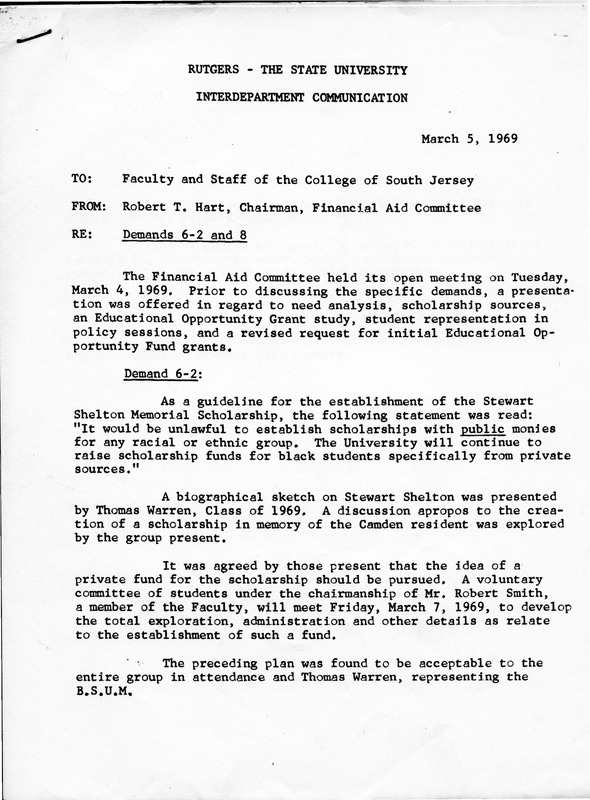
Memo from Robert T. Hart, Chairman of the Financial Aid Committee of the College of South Jersey (Rutgers-Camden), issued on March 5, 1969, regarding the Black Student Unity Movement's demands related to financial aid.
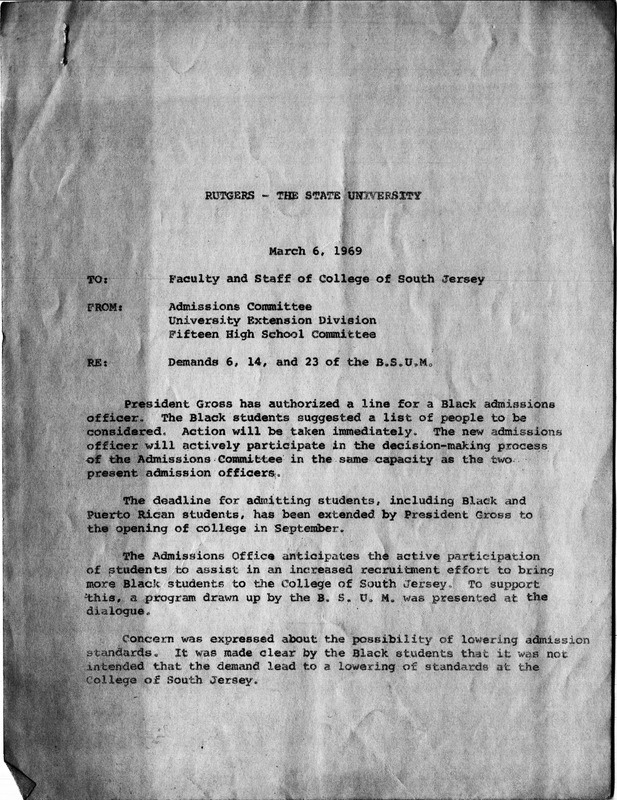
Memo from the Admissions Committee of the College of South Jersey (Rutgers-Camden), issued on March 6, 1969, regarding the Black Student Unity Movement's demands related to admissions. Attached is a Presentation by the University Extension Division Concerning Demand #23, submitted by Lamond H. Smith on March 3, 1969.
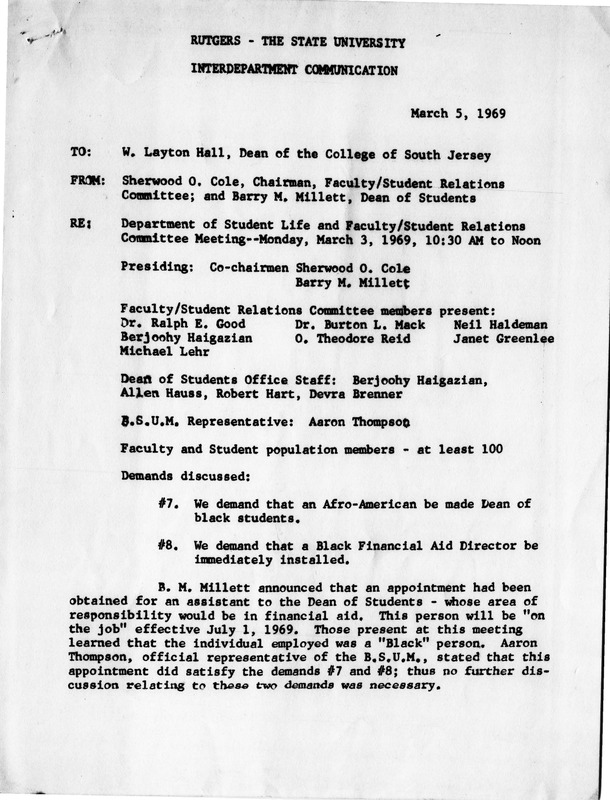
Memo from Sherwood O. Cole, Chairman of the Faculty/Student Relations Committee, and Barry M. Millett, Dean of Students, to W. Layton Hall, Dean of the College of South Jersey (Rutgers-Camden), issued on March 5, 1969. Cole and Millett report about a meeting related to the Black Student Unity Movement's demands that took place on March 3, 1969. Student Aaron Thompson represented BSUM at the meeting. BSUM demands number 7, 8, 9, and 16 were discussed.
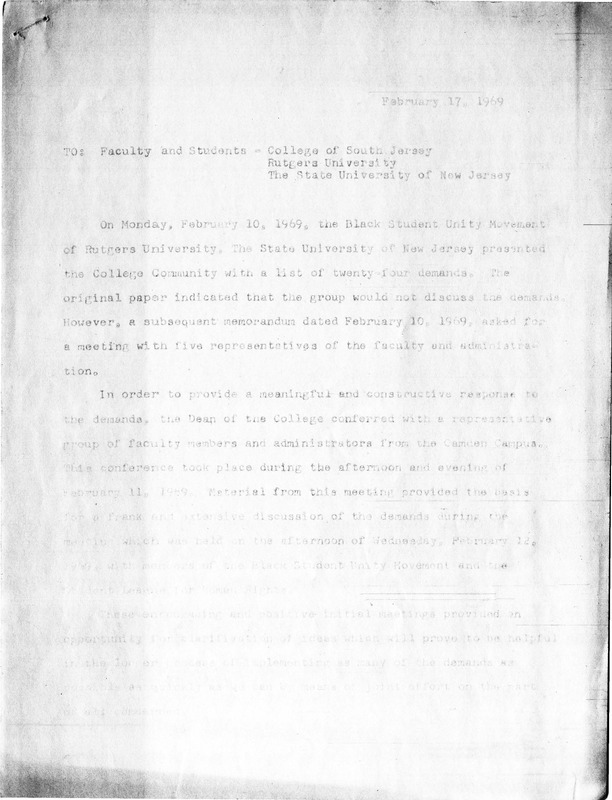
Copy of memo to Faculty and Students at the College of South Jersey (Rutgers-Camden), issued on February 17, 1969, regarding the Black Student Unity Movement's 24 demands. Although unsigned, it appears the memo was issued by the office of W. Layton Hall, the Dean of the College of South Jersey.
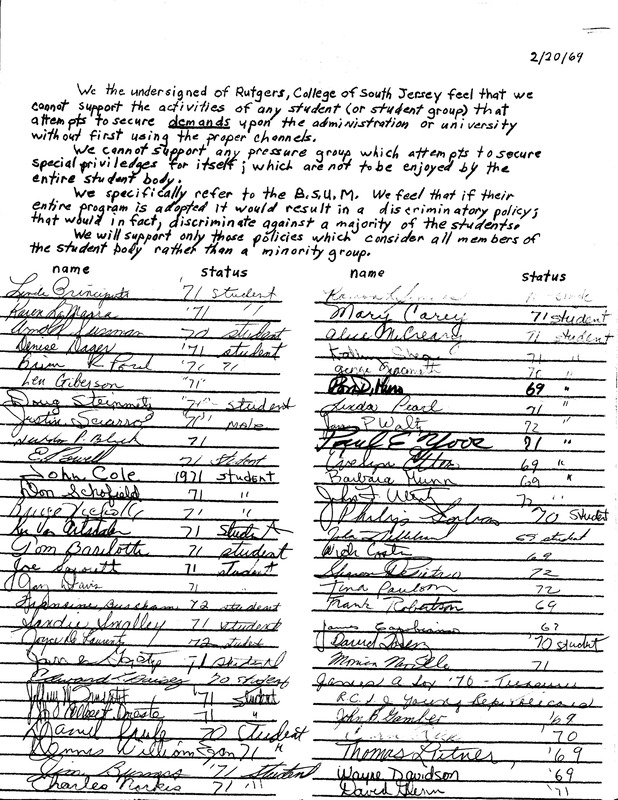
Copy of a petition with approximately 150 signatures of Rutgers-Camden students opposing the activities and demands of the Black Student Unity Movement (BSUM).
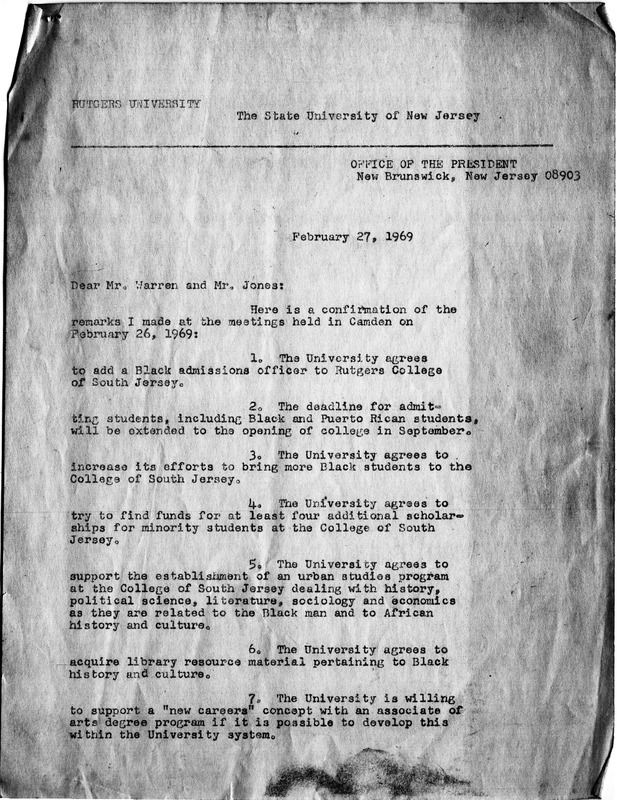
Letter from Rutgers President Mason W. Gross, dated February 27, 1969, to Rutgers–Camden students Thomas Warren and Roy Jones. The letter serves as a confirmation of the remarks that the president made at the meeting in Camden on February 26, 1969, regarding the Black Student Unity Movement's demands.
Prepared by Roy Jones, President of the Black Cooperative Association and member of the Black Student Unity Movement, this proposal outlines a plan to establish a student cooperative complex at Rutgers-Camden. The document includes information about the history and philosophy of the Black Cooperative Association, which was formed on March 20, 1969. The proposal explains that the Black Cooperative Association has already purchased a house at 301 N. 2nd St. and plans to purchase the adjacent property at 303 N. 2nd St. The proposal requests financial support from the university in the form of a loan to cover the purchase price of the second house and renovation costs.
The houses mentioned were located at the northwest corner of N. 2nd St. and Penn St., and they have since then been demolished.
The exact date of the proposal is not listed on the document, but its content suggests that it was written during the fall semester of 1969, because it refers to March 1969 as occurring "last semester."
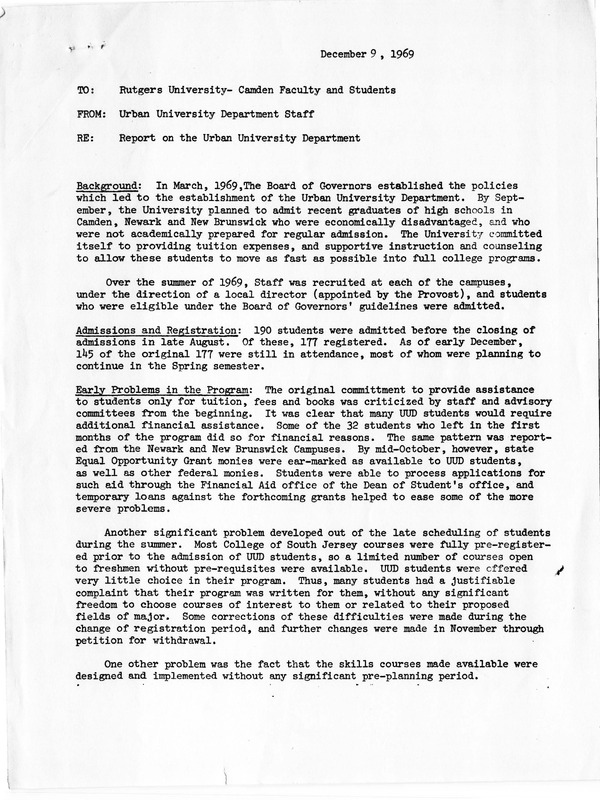
Two-page report from the Urban University Department (UUD) staff regarding the department's problems and progress since the program's inception at Rutgers–Camden in March of 1969. The report mentions the constructive criticism provided by the Black Student Unity Movement (BSUM) during UUD's early development.
UUD was an administrative and support initiative focused on college access, providing financial aid, remedial "skills" courses, and counseling for disadvantaged students. This program functioned as a support service to help students transition into the university and eventually evolved into the Educational Opportunity Fund (EOF) and academic foundation structures for student success.
UUD is not to be confused with the Urban Studies curricular program that also grew out of BSUM activism on campus.
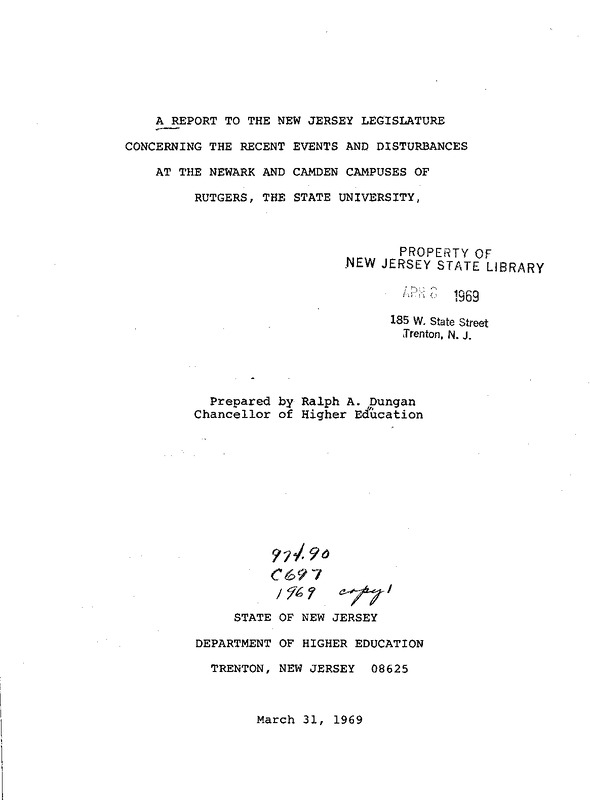
A report to the New Jersey Legislature prepared by Ralph A. Dungan, Chancellor of Higher Education, concerning the Black students' protests at Rutgers-Newark and Rutgers-Camden in February of 1969. The report includes a chronology of the events at Newark and Camden and a list of recommendations. Nine appendices are attached, including a list of demands from the Black Organization of Students at Rutgers-Newark, a list of demands from the Black Student Unity Movement at Rutgers-Camden, a resolution adopted by the Rutgers Board of Governors on March 14, 1969, and other memos related to the protests.
Author takes a hardline stance against the actions of Black students who protested the selection of an all-white administran for the Urban University Division by damaging parts of the library.
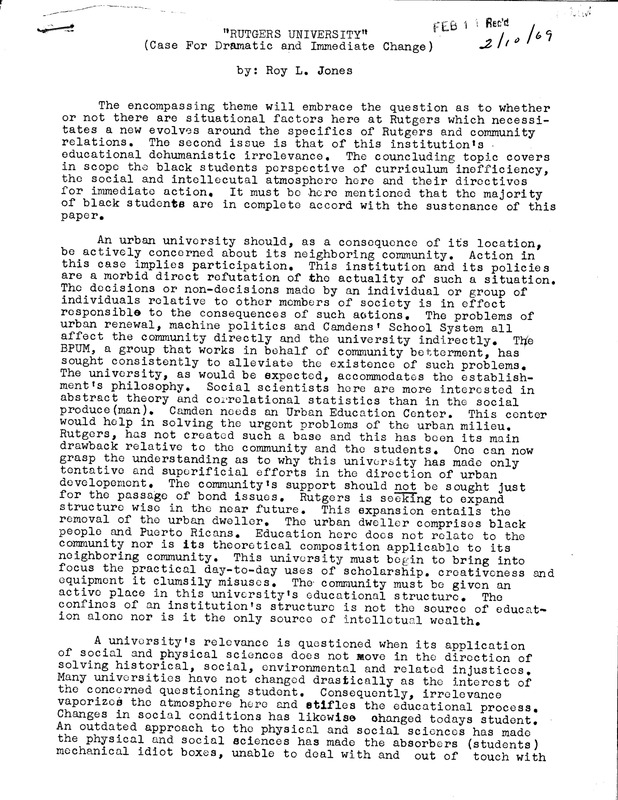
In this essay, Roy L. Jones discusses the relationship between the Rutgers University and the surrounding community in Camden, which is predominantly Black and Puerto Rican. Jones makes the case that, as an urban university, Rutgers should reconsider its impact, structure, and responsibility to the Camden community, as well as to the Black and Puerto Rican student populations.
Following Jones's essay, the document concludes with an evocative piece of writing by Myrna Williams, titled "Black Feeling," which addresses the alienation Williams feels as a Black student on campus.
This article discusses the vandalism charges against the specific individuals who were involved in the library protest. They include specific names of the indivudials involved.