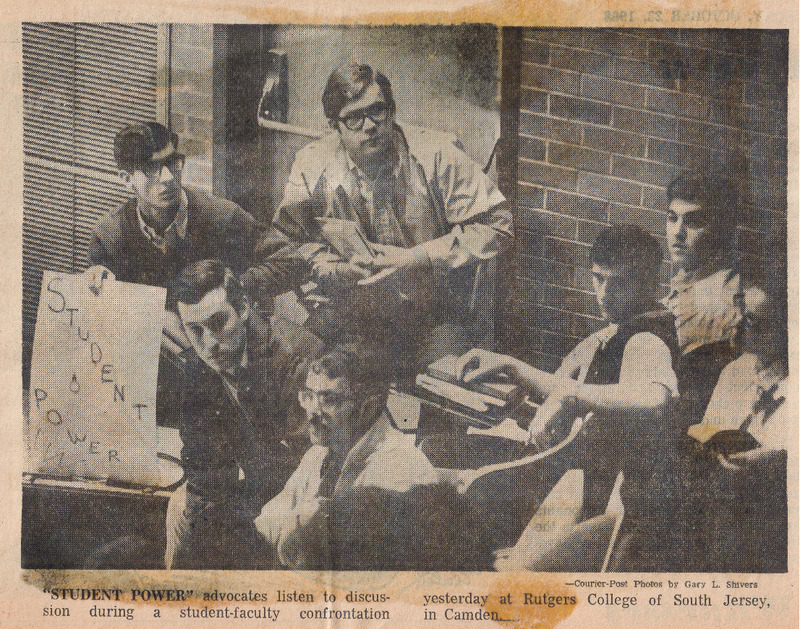
Nearly 200 Rutgers students protest at a faculty meeting, advocating for greater student involvement in policy decisions. Some discussions have occurred, but the students want less talk and more action. The article is accompanied by a photograph of student activists with a sign that says "Student Power."
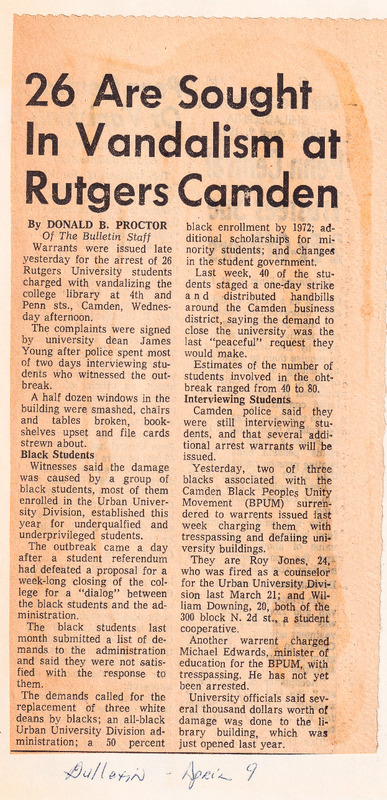
This article discusses the vandalism charges against the specific individuals who were involved in the library protest. They include specific names of the indivudials involved.
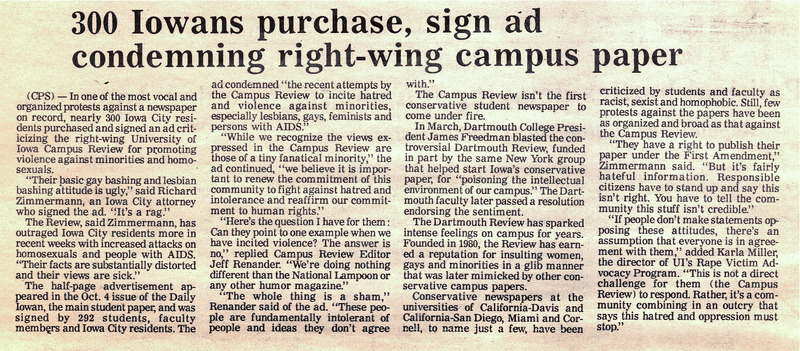
Article about a large protest on the University of Iowa against a right-wing publication for being homophobic and bigoted. The article discusses free speech, homophobia, racism, and sexism. College Press Service (CPS) and syndicated to the Gleaner.
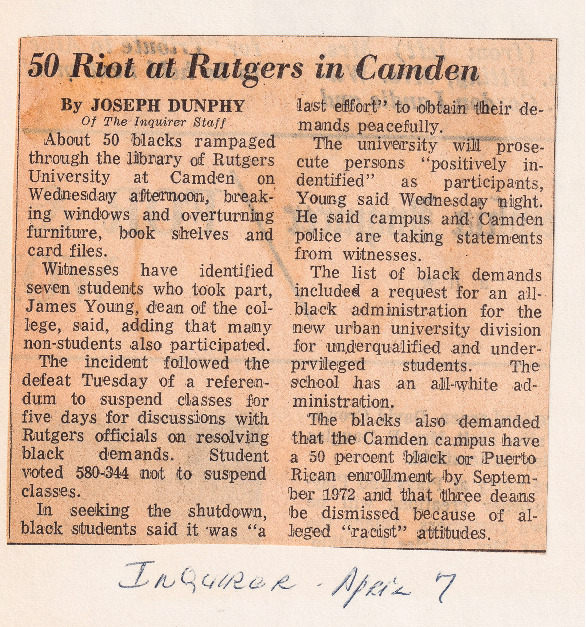
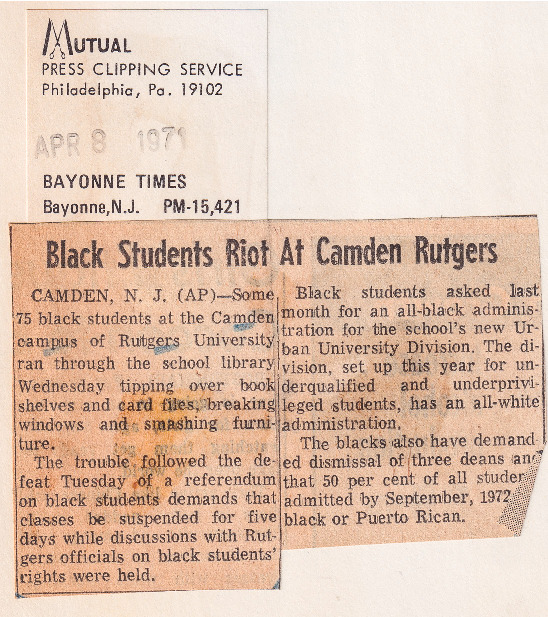
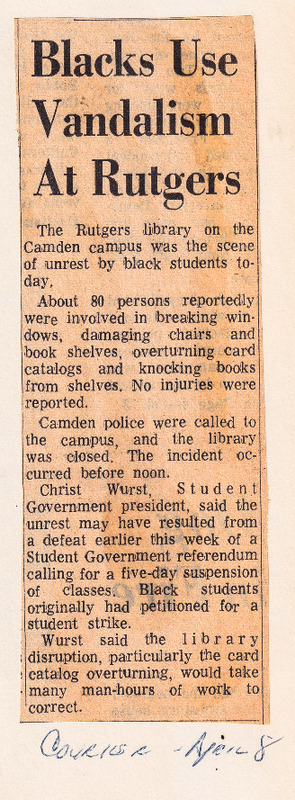
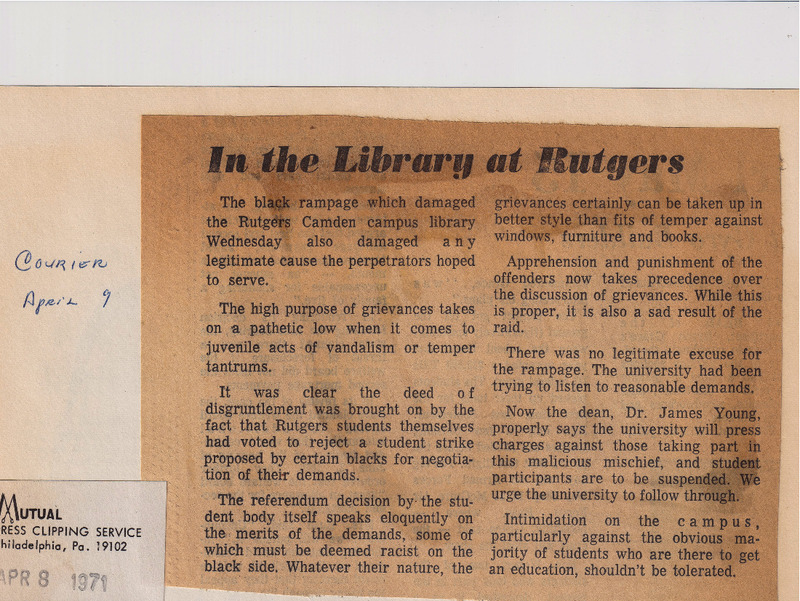
Author takes a hardline stance against the actions of Black students who protested the selection of an all-white administran for the Urban University Division by damaging parts of the library.
A complete three-disc 78rpm album set titled "6 Songs for Democracy: Discos de Las Brigadas Internacionales," featuring Ernst Busch and the Chorus and Orchestra of the 11th International Brigade. The songs are performed in Spanish and German. Originally recorded in Barcelona in 1938 during the Spanish Civil War, these discs were manufactured by Keynote Recordings, Inc. and released by The Music Room (133 West 44th Street, New York City, N.Y.).
The tri-color (white, red, and yellow) album sleeve depicts five Spanish Republican soldiers, one carrying a guitar. This specific copy is significant for a handwritten inscription on the interior sleeve by Paul Robeson, which reads:
"These songs of the Spanish struggle
deeply reflect the democratic spirit.
That spirit like Joe Hill 'never died.'
This album is a 'must.'
Sincerely,
Paul Robeson."
Each disc features a red and gold label with the logo of the International Brigade of the Spanish Republic. Labels include the text: "Originals made in Barcelona Spain, 1938. US copyright reserved."
The label for track 1B ("Lied Der Einheitsfront") includes a Spanish-language sticker regarding the recording conditions: "La impresión defectuosa de este disco es debida a last interrupciones de energia eléctrica durante un bombardeo" (The defective printing of this record is due to the interruptions of electrical energy during a bombardment).
This edition was originally issued with a descriptive booklet; however, that component is not included in the copy of the record held by Special Collections.
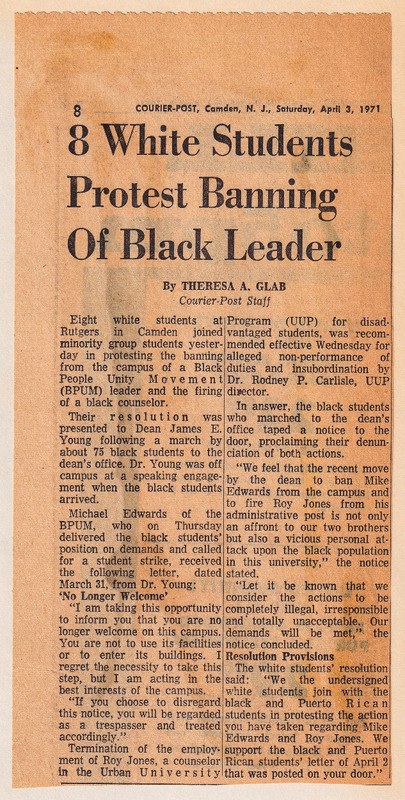
Describes the banning of a Black Student Unity Movement (BSUM) leader. In response a multiracial coalition of students , including 8 White students protest.
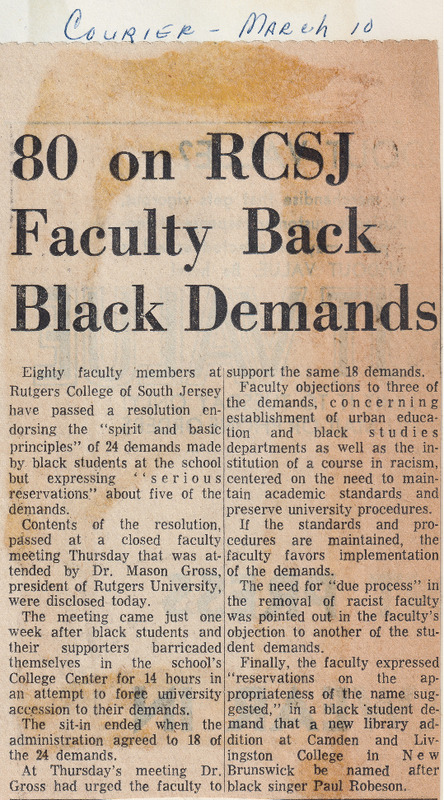
Eighty faculty members have backed the student demands, although they have "reservations" about the appropriateness of renaming the library. The article also discusses the sit-in ending after faculty agreed to 18 of the 24 stated demands.
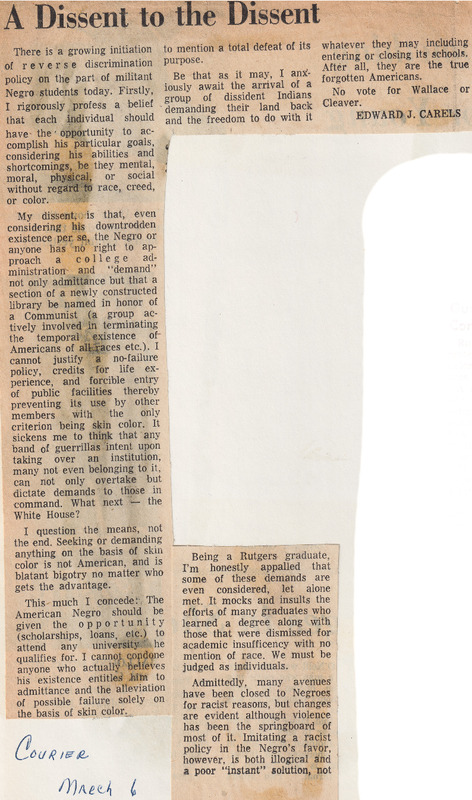
The author strongly opposes admittance of students "without qualifications," specifically discussing Black students whose academic achievements may not have qualified them for Rutgers admission without the established programs. He sarcastically discusses the possibility of Native Americans reclaiming the land on which Rutgers sits and asking for admittance to the school.
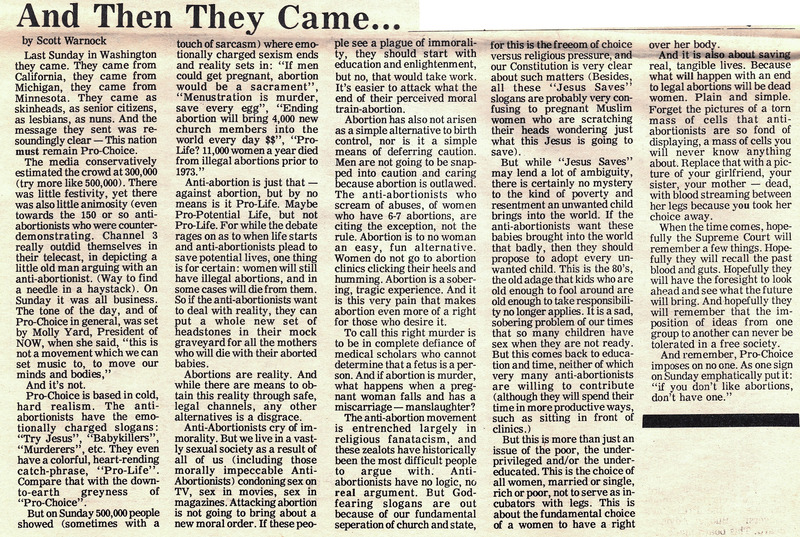
Warnock discusses abortion and argues that the pro-life movement is entrenched in religion and is not realistic. He argues for access to abortion to save women's lives and recognizes that it is a difficult decision for women.
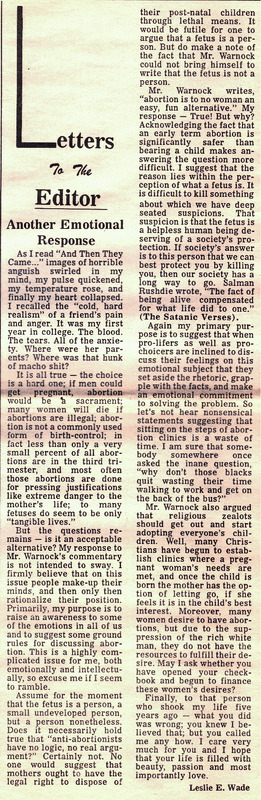
This letter from Leslie E. Wade discusses the issue of abortion and is in response to a previous article published in The Gleaner, "And Then They Came..." Wade reflects on the emotional and intellectual complexity of the issue.
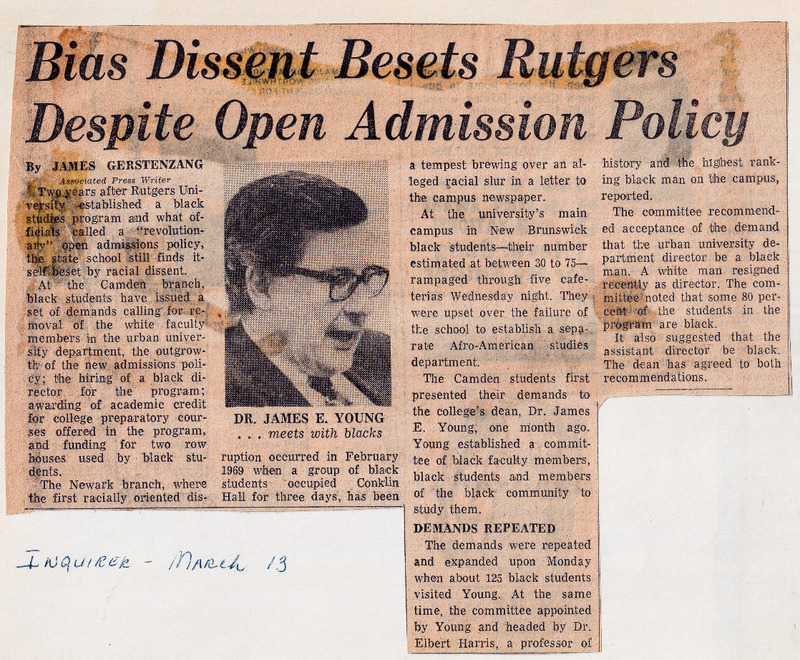
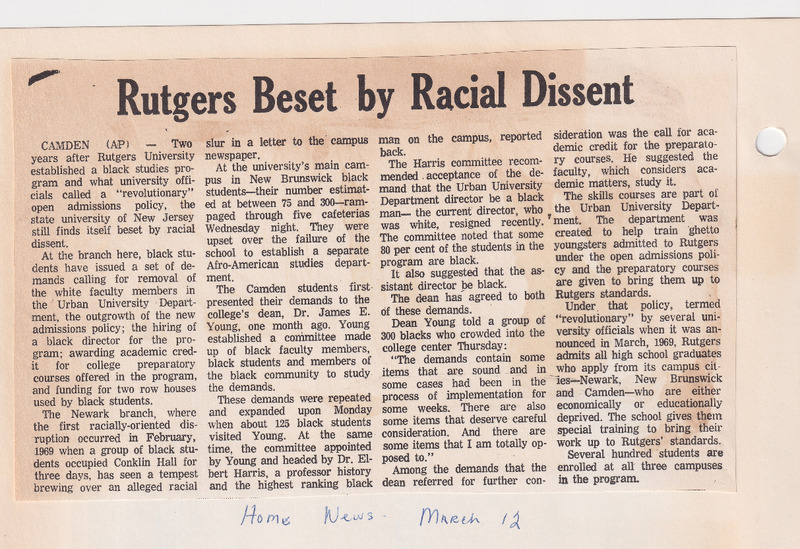
Black Students at Rutgers are still fighting for representation at Rutgers in a multitude of areas, despite Rutgers introducing a "revolutionary" open admissions policy.
Flyer for GI Day events at the University of Pennsylvania on Saturday, March 1, 1969. The events were organized under the auspices of the Ultimate Weapon, which was a newsletter published in Philadelphia by the Fort Dix Free Speech Movement (an organization of GIs from Fort Dix, New Jersey).
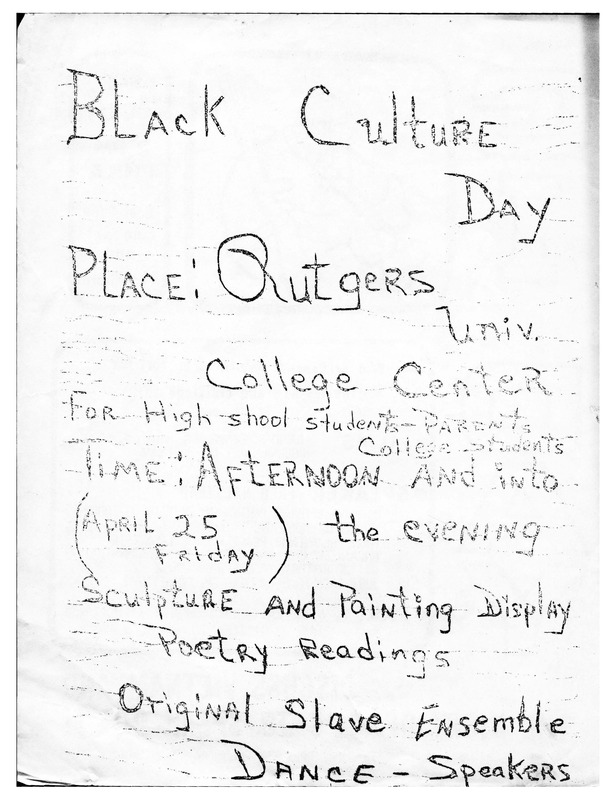
The reverse side of the flyer was used by Rutgers–Camden students for a mimeographed message promoting Black Culture Day at the College Center on Friday, April 25, 1969. Note that the flyer does not explicitly state the year of the events, but supplemental research revealed that this archival item is from 1969.
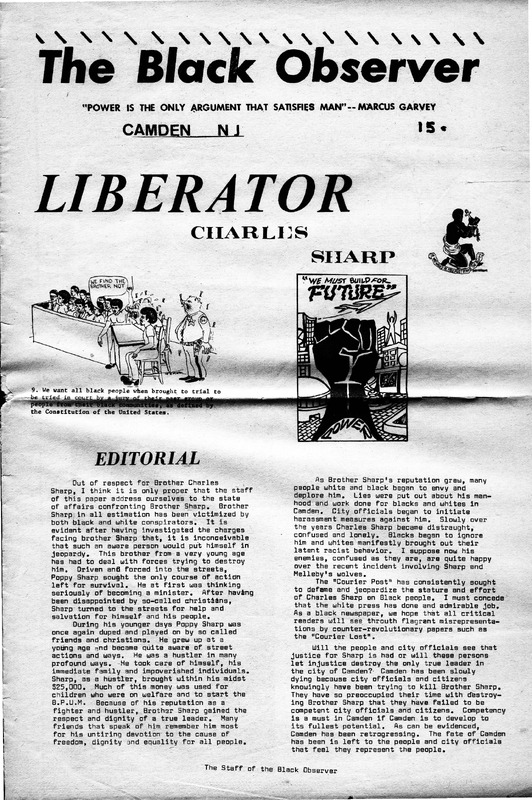
Complete 8-page issue of the Black Observer newsletter from Camden, NJ, circa fall 1969. The precise date is not printed on the issue. Rutgers-Camden students affiliated with the Black Student Unity Movement (BSUM) produced this paper for the community. Names of the editors and contributors printed on the back page are Roy Jones, Marie Spearman, Faye Waters, Myrna Williams, Vince Mayfield, Carolyn Williams, Ralph Spencer, Richard Rhodes, Alice Syms, Linda Ellis, R. Eugene Kirkland, Lillian Matthews, Fredia Bodie, Betty Coleman. A letter from Aaron G. Thompson on behalf of the Rutgers BSUM is printed on page 5.
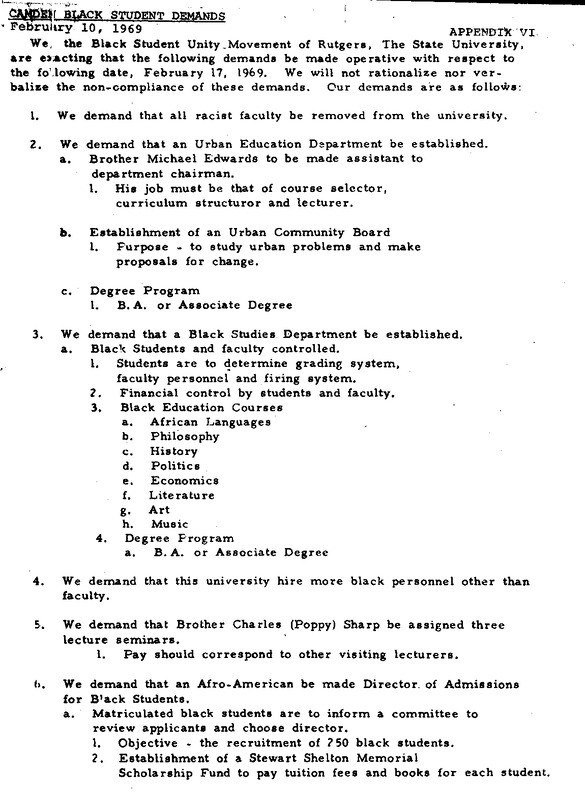
24 demands presented by the Black Student Unity Movement to Rutgers University–Camden on February 10, 1969. The demands were distributed widely on campus, and multiple copies have been preserved in Special Collections at the Paul Robeson Library in Camden and at the Alexander Library in New Brunswick. This copy is from Appendix VI in Ralph A. Dungan's 1969 Report to the New Jersey Legislature Concerning the Recent Events and Disturbances at the Newark and Camden Campuses of Rutgers, the State University.
Author takes a hardline stance against the actions of Black students who protested the selection of an all-white administran for the Urban University Division by damaging parts of the library.
Author takes a hardline stance against the actions of Black students who protested the selection of an all-white administran for the Urban University Division by damaging parts of the library.
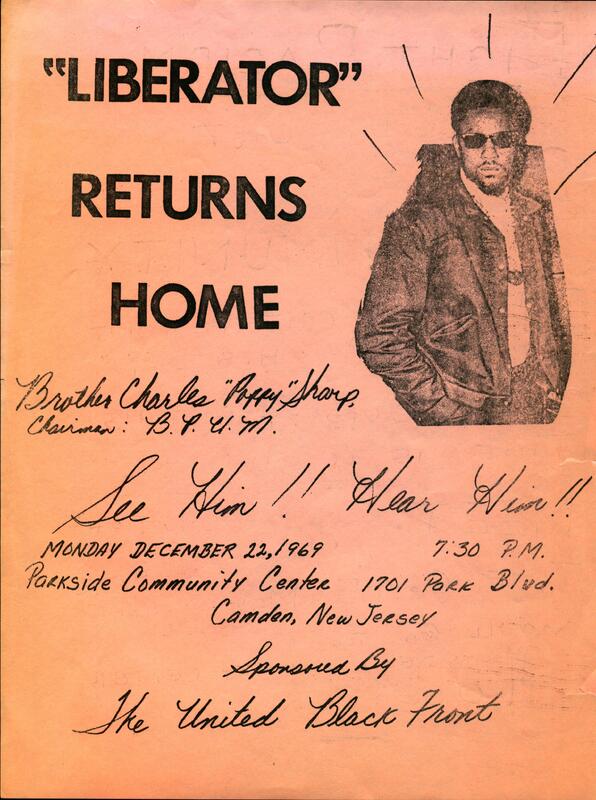
Double-sided flyer for a December 22, 1969, event with Charles "Poppy" Sharp, chairman of the Black People's Unity Movement (BPUM) in Camden, sponsored by the United Black Front. The front of the flyer has an image of Sharp and event details. The back of the page reads "Fight Racism Support the Black Community" and tells Rutgers-Camden students to meet up in front of the College Center 45 minutes before the event and walk to the Parkside Community Center together.
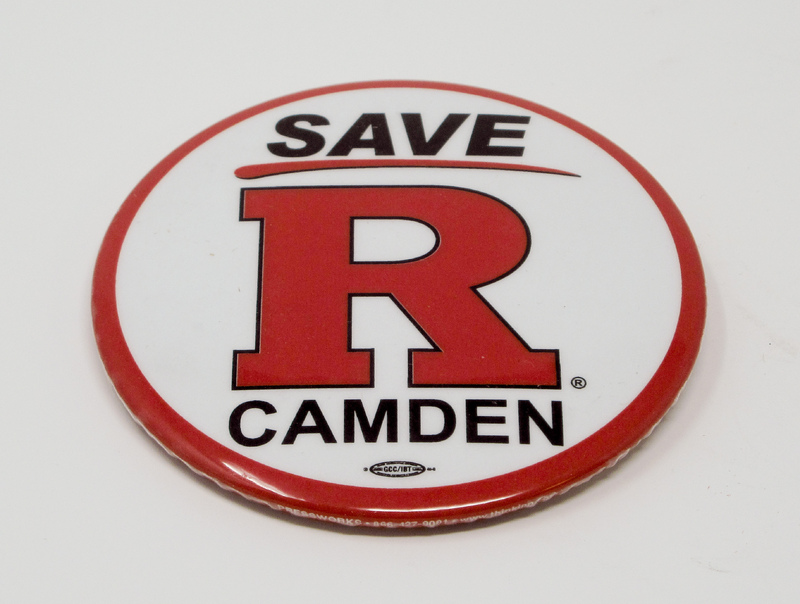
Button with the Rutgers "R" logo in the center and the wrapped with the text "Save Camden." In opposition to Chris Christie's effort to merge Rowan University with Rutgers University - Camden.
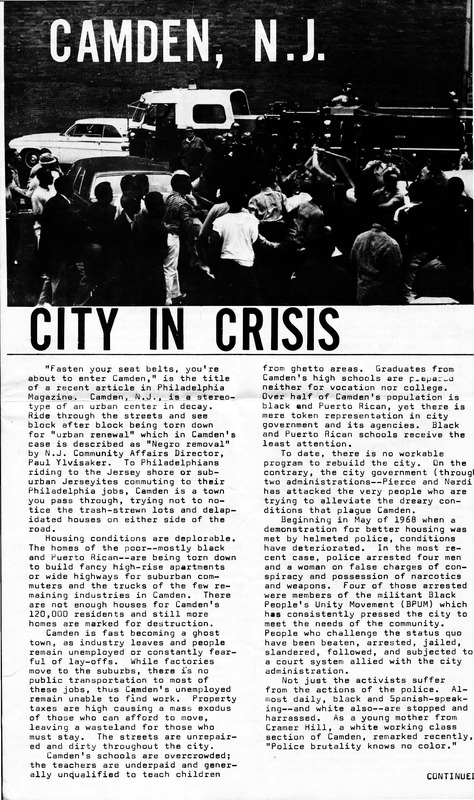
City in Crisis newsletter produced by the Camden Defense Committee in October 1969. The newsletter includes information about BPUM and the arrest of the Camden five during a raid on September 8, 1969. The committee's address is listed as 314 Linden Street, Camden, NJ. Father Robert Weber serves as chairman pro tem and David Berger serves as treasurer.
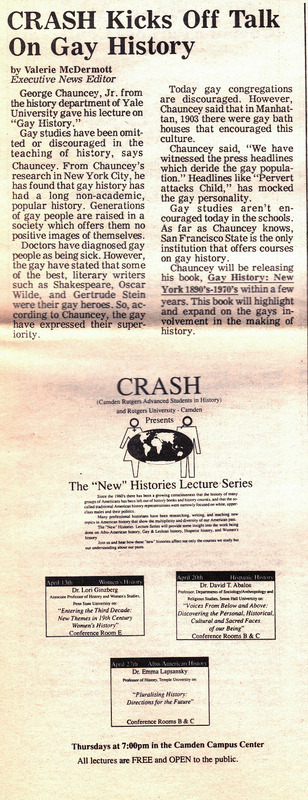
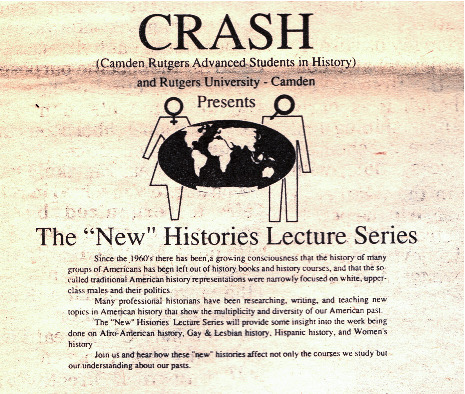
The student organization Camden Rutgers Advanced Students in History (CRASH) presented the "New" Histories Lecture Series, which kicked off with a talk on gay history by George Chauncey, Jr. of Yale University.
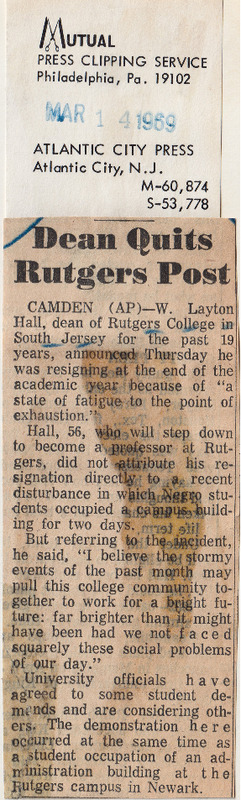
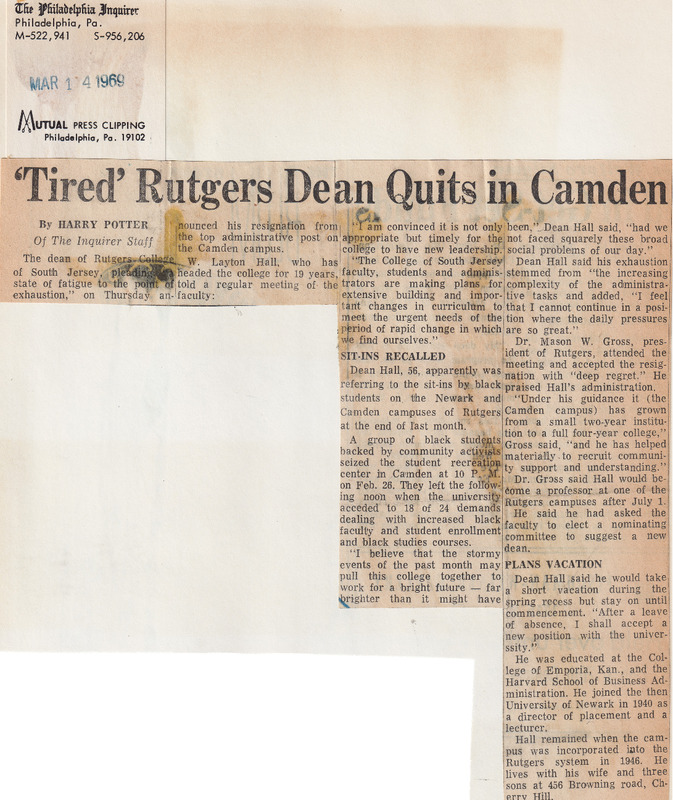
Layton Hall, former dean, is resigning at the end of the academic year. He did not claim that the student protests caused this resignation but stated that the protests will hopefully bring students together to address modern social problems.
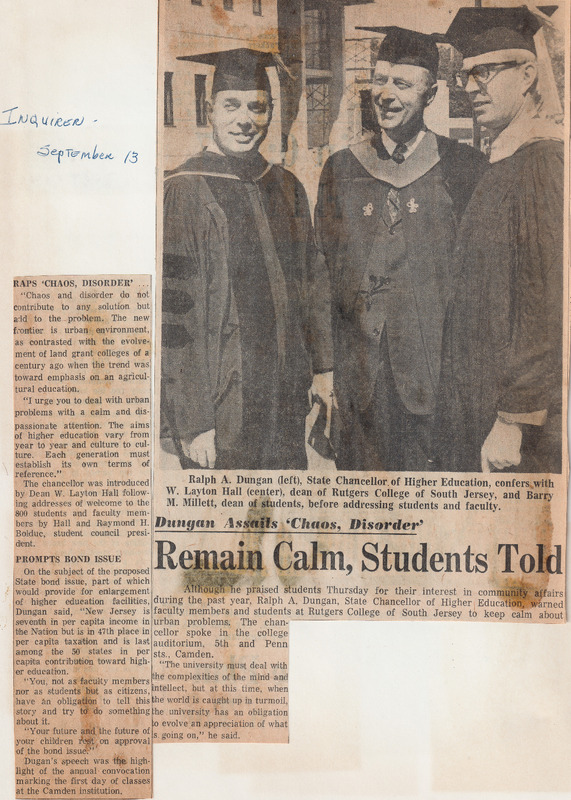
Ralph A. Dungan, State Chancellor of Higher Education, warns Rutgers students to stay calm about "urban problems" and that they should stay "calm and dispassionate." He also advocated for students to approve a state bond issue that would pay more towards higher education. The article is accompanied by a photograph of Ralph A. Dungan together with W. Layton Hall, Dean of Rutgers College of South Jersey, and Barry M. Millett, Dean of Students.
Article detailing a presentation on campus by Charlotte Bunch, a feminist activist. She discusses feminism in a global context and its intersection with human rights.
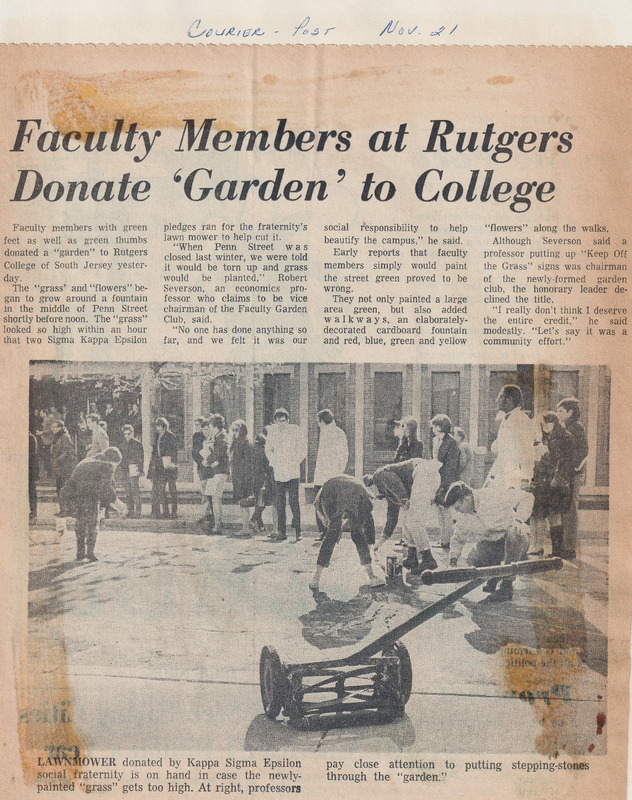
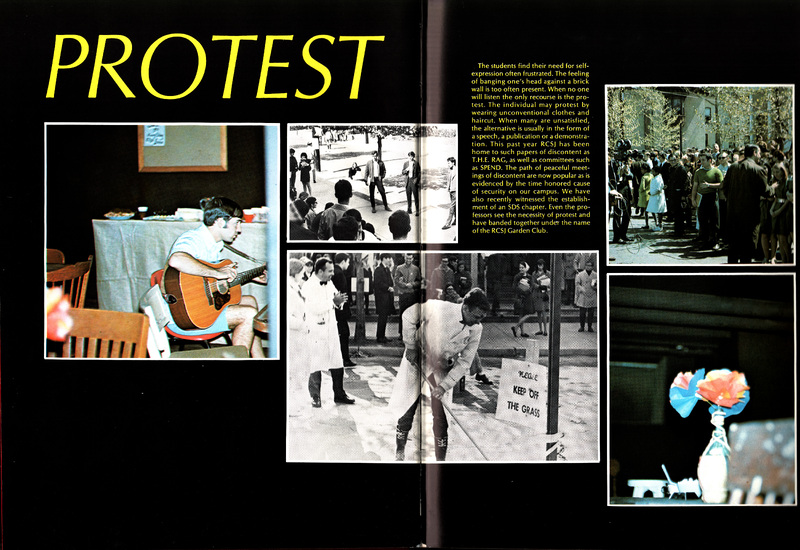
Rutgers faculty paint a faux garden on Penn Street to beautify campus. The university had promised to plant grass there but had not followed through, so they took it into their own hands.
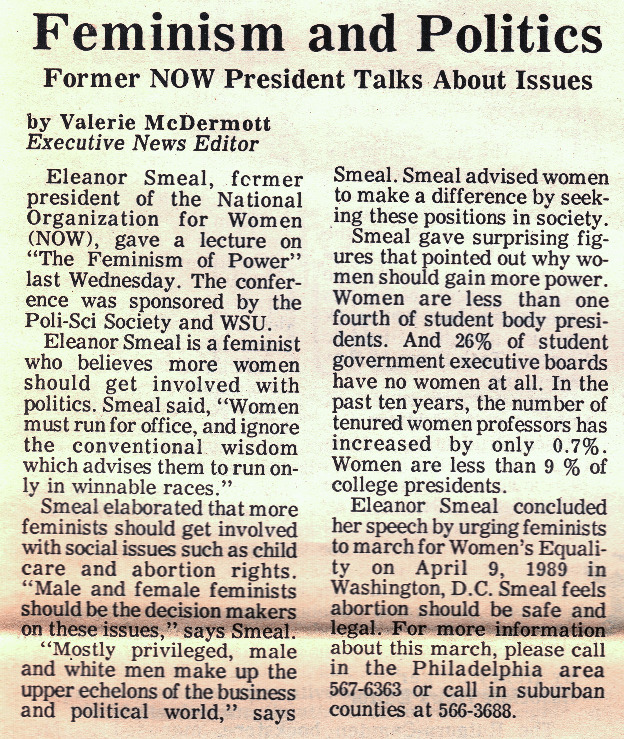
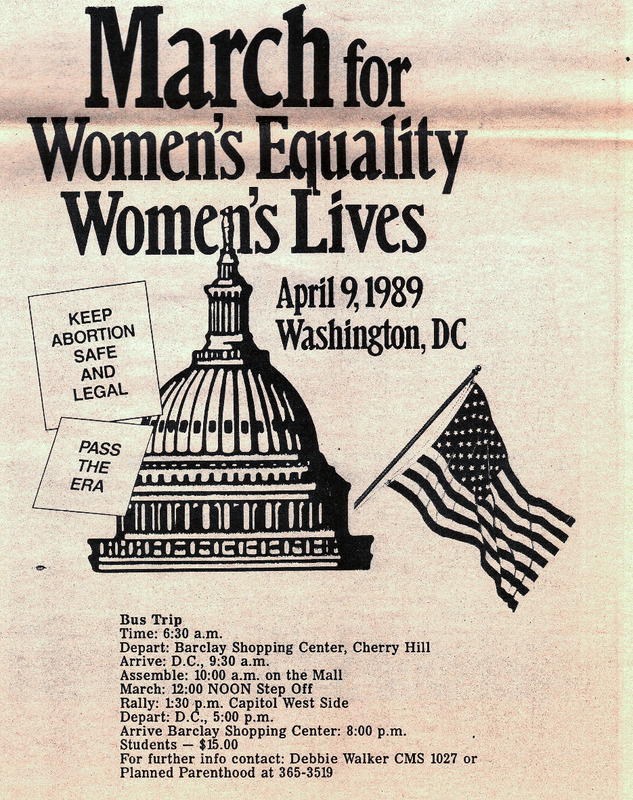
This article is about a lecture given by Eleanor Smeal on campus who called for more feminists engage in social issues like, abortion rights and child care. She also urged women to seek out more leadership positions and attend a march on Washington for Women's Equality.
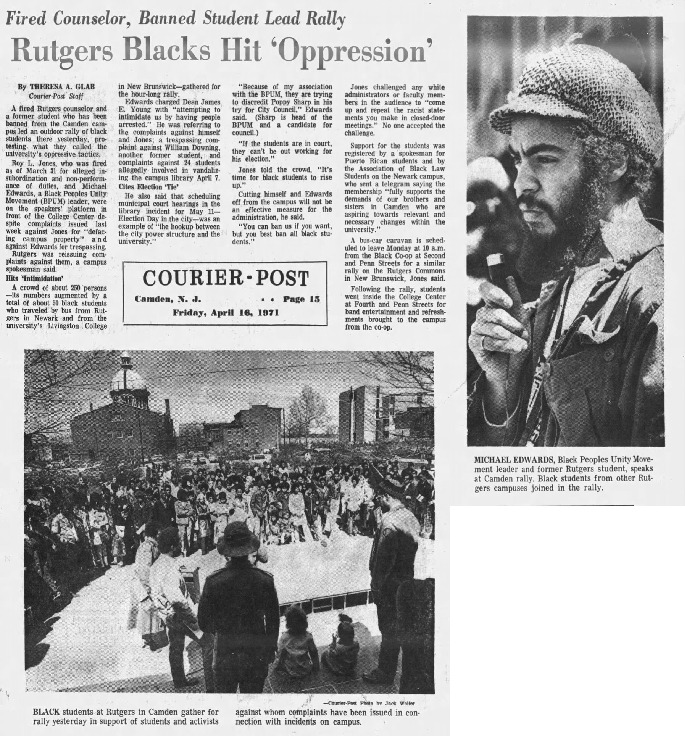
News article about the Black students' rally at Rutgers University–Camden, mentioning Roy Jones, Michael Edwards (later Malik Chaka), and the Black People's Unity Movement (BPUM).
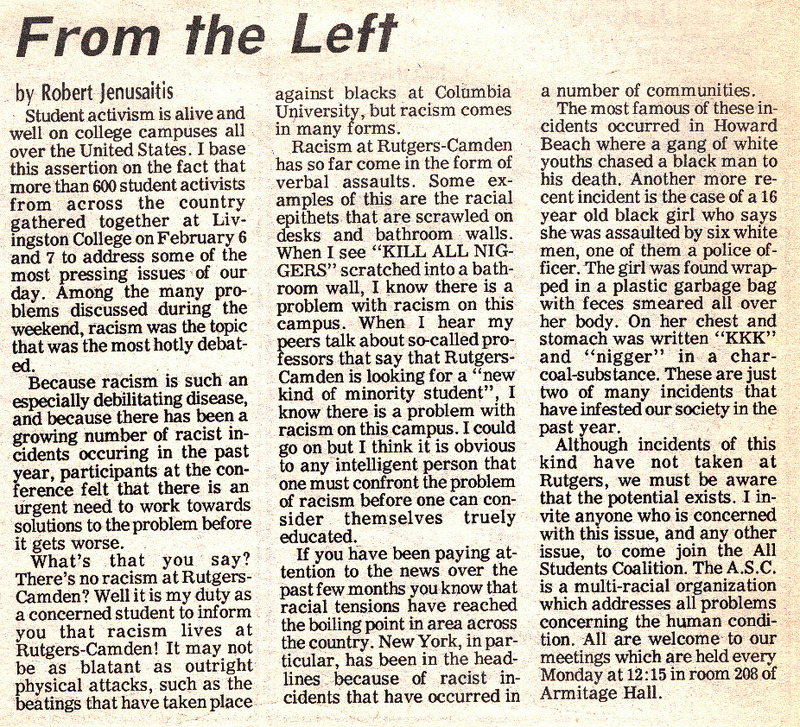
In the column "From the Left," Robert Jenusaitis asserts that student activism is thriving following a national conference at Livingston College and calls for students to join the All Students Coalition (A.S.C.) to combat racism on the Rutgers-Camden campus. He highlights the urgency of the issue by citing racial epithets found in campus buildings and comparing the local climate to high-profile racial violence cases in Howard Beach and New York.
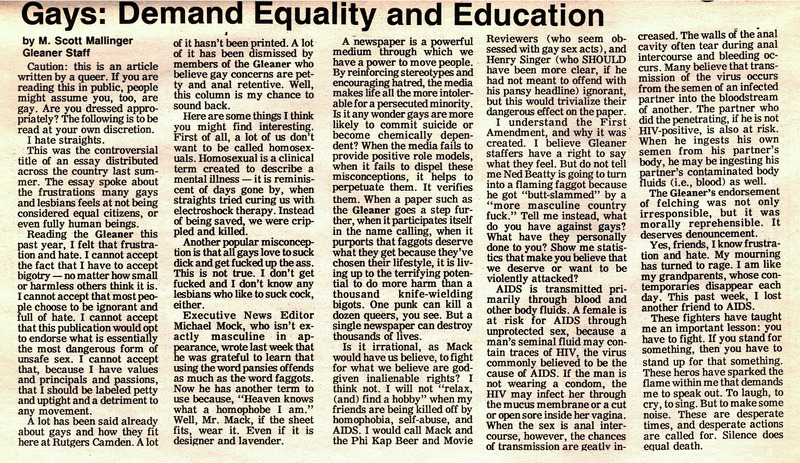
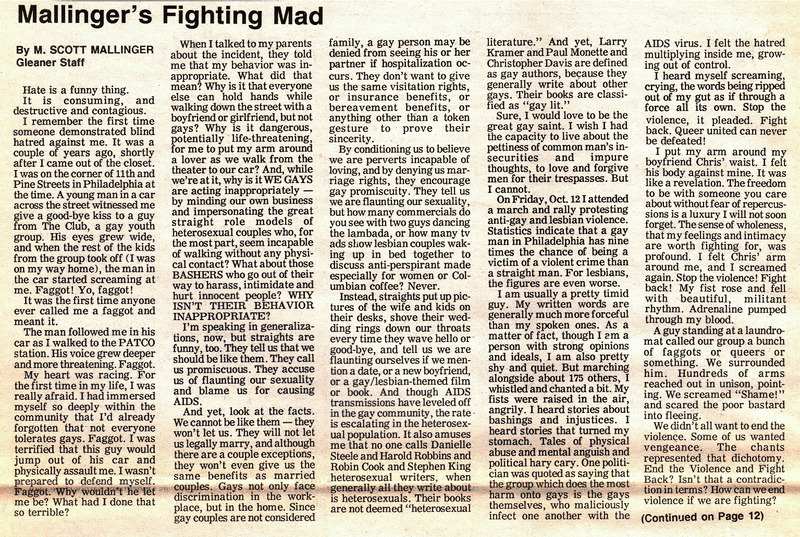
Mallinger's column criticizes the Gleaner's previous use of the word "pansy" in a headline and how it further spread homophobia on Rutgers-Camden's campus. Moreover, Mallinger explains how AIDS is commonly contracted and how his experiences with death and homophobia push him to speak out for the gay community.
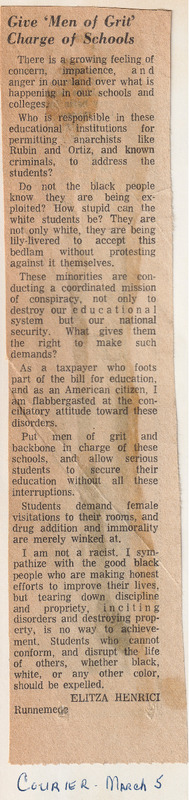
The author protests against "anarchists" and "criminals" being allowed to address college students, as well as "female visitation" to students' rooms being permitted. She concludes that "men of grit" need to be placed in charge of schools, for the benefit of all students, Black and white.
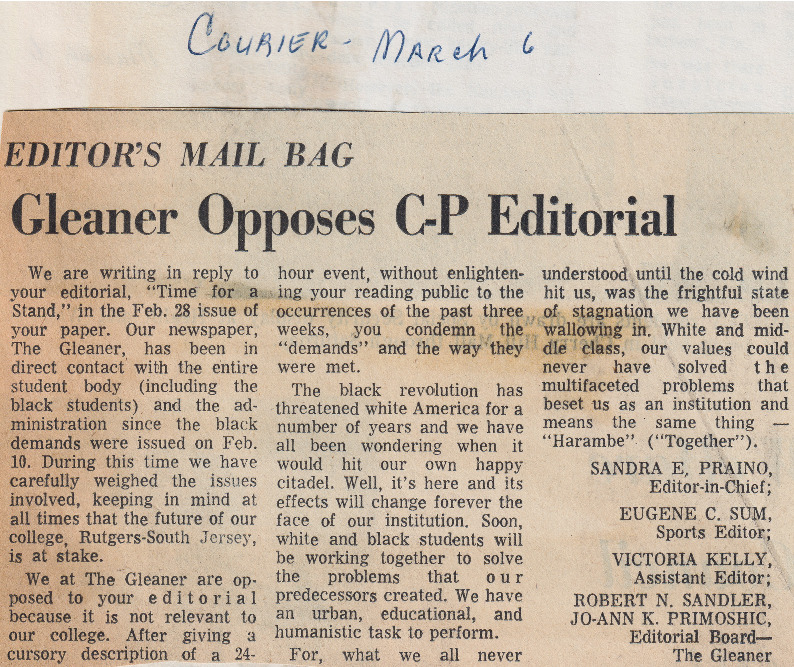
The editors of the Gleaner write in to the Courier-Post, opposing a recently published editorial about the events of the sit-in. They state that they have been in contact with much of the student body, and the editorial is irrelevant, not detailed enough, and fails to give the important context of the past three weeks, which have led to the students working together to solve institutional problems.
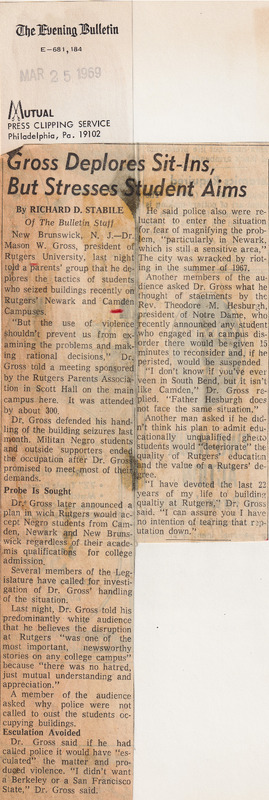
Reporting on a meeting between Dr. Gross and angry parents, the Bulletin author notes that while Gross rejected the need for violence, he did not believe that should prevent them from examining the claims of those students. He also noted that the situation in Camden was different than that in other schools with protests, and believed that calling the police would have only escalated the violence.
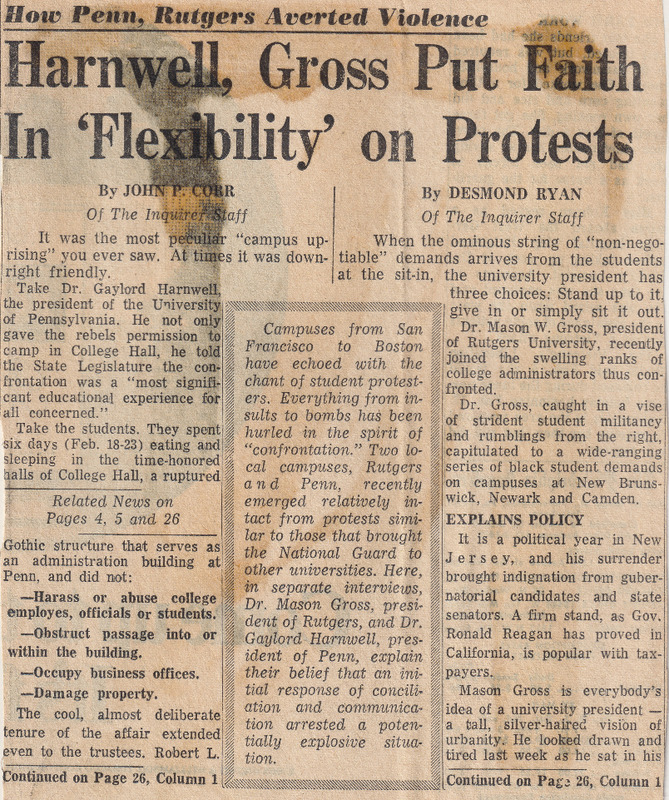
The openings of two interviews with college presidents, one Dr. Gross, about recent protests. The article also notes that there have been widespread student protests across the nation recently.
Author takes a hardline stance against the actions of Black students who protested the selection of an all-white administran for the Urban University Division by damaging parts of the library.
The articles is about Mallinger's personal experience with homophobia and bigotry as a gay man. He describes attending a protest against anti-gay and lesbian violence in Philadelphia and the joy of being among other queer people. He finishes saying that several individuals were attacked during the protest.
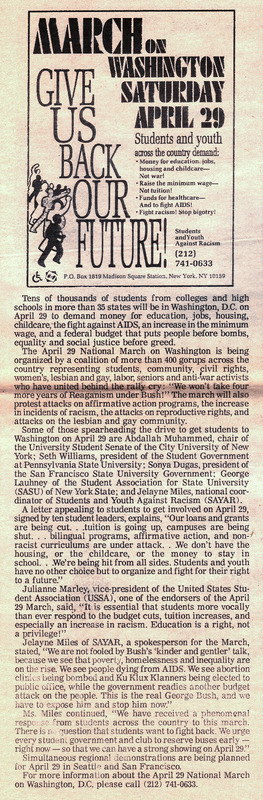
This is an advertisement for an upcoming march on Washington, DC, for more funding for education, housing, jobs, the AIDS epidemic, and increasing the minimum wage. The protest is organized by a coalition of several hundred groups focused on equity, social justice, racism, sexism, affirmative action, homophobia, etc.
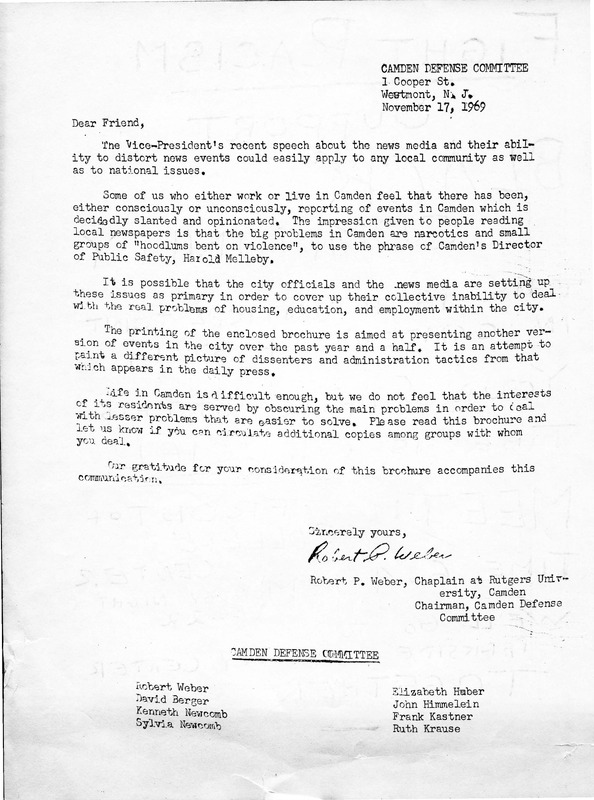
Camden Defense Committee memo dated November 17, 1969, signed by Robert P. Weber, Chaplain at Rutgers-Camden, regarding a brochure about urban problems in Camden (see the related item: City in Crisis brochure). Defense committee members listed are Robert Weber, David Berger, Kenneth Newcomb, Sylvia Newcomb, Elizabeth Huber, John Himmelein, Frank Kastner, and Ruth Krause. The reverse side of the memo was used by Rutgers-Camden students in December 1969 for a mimeographed flyer. The flyer says "Fight Racism Support the Black Community" and urges students to meet up at the front of the College Center on December 22, 1969, and then go together to the Parkside Community Center for a BPUM event (see the related item: BPUM Liberator Returns Home / Fight Racism flyer).
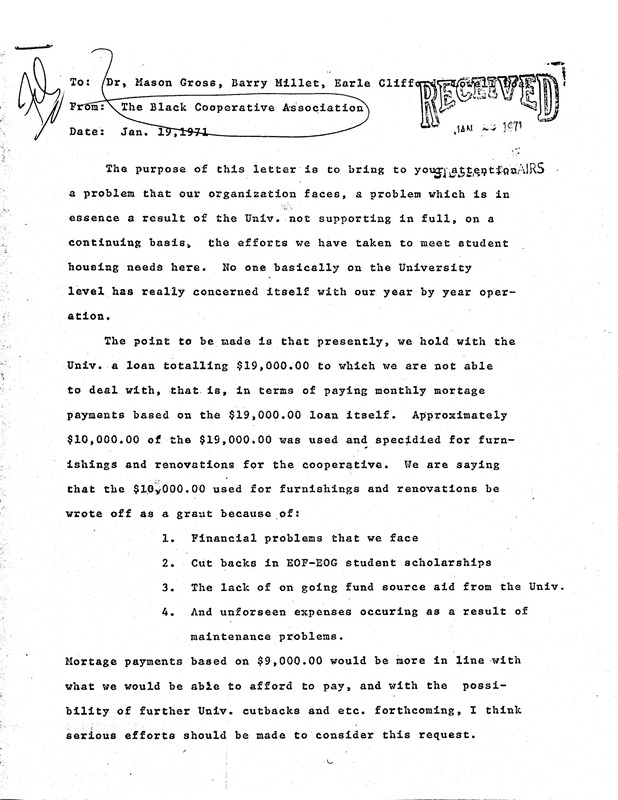
Memo from the Black Cooperative Association to Rutgers University President Mason Gross, Dean of Students Barry Millet, and Dean of Student Affairs Earle Clifford, signed by Roy L. Jones on January 19, 1971. The memo addresses the financial challenges facing the Black Cooperative Association in their endeavor to create cooperative student housing at Rutgers-Camden.
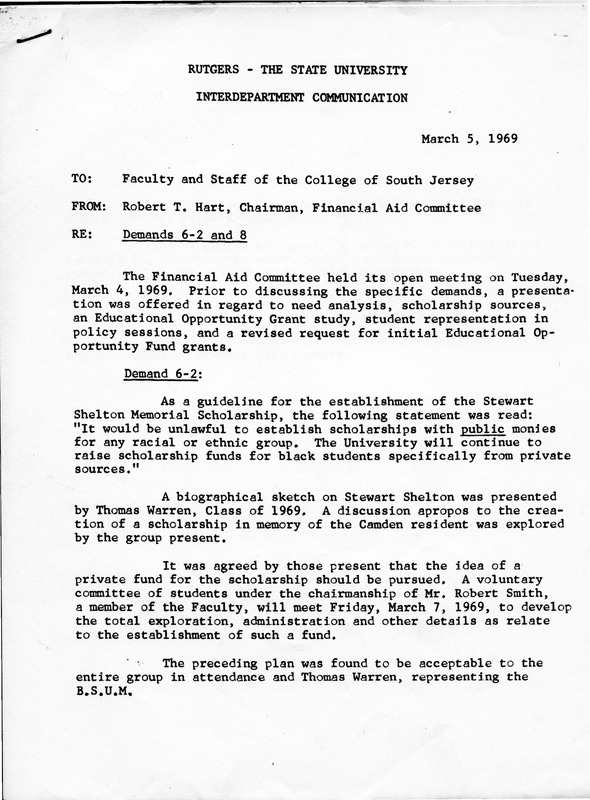
Memo from Robert T. Hart, Chairman of the Financial Aid Committee of the College of South Jersey (Rutgers-Camden), issued on March 5, 1969, regarding the Black Student Unity Movement's demands related to financial aid.
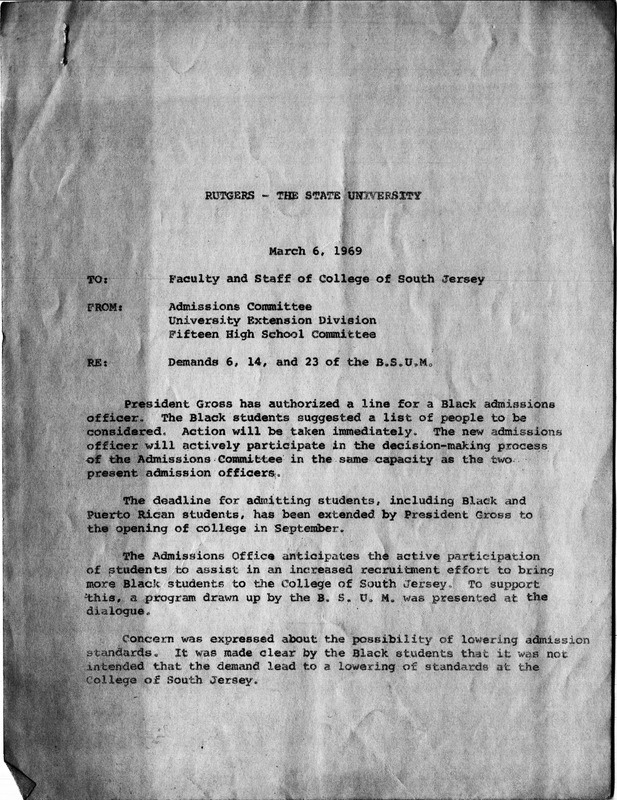
Memo from the Admissions Committee of the College of South Jersey (Rutgers-Camden), issued on March 6, 1969, regarding the Black Student Unity Movement's demands related to admissions. Attached is a Presentation by the University Extension Division Concerning Demand #23, submitted by Lamond H. Smith on March 3, 1969.
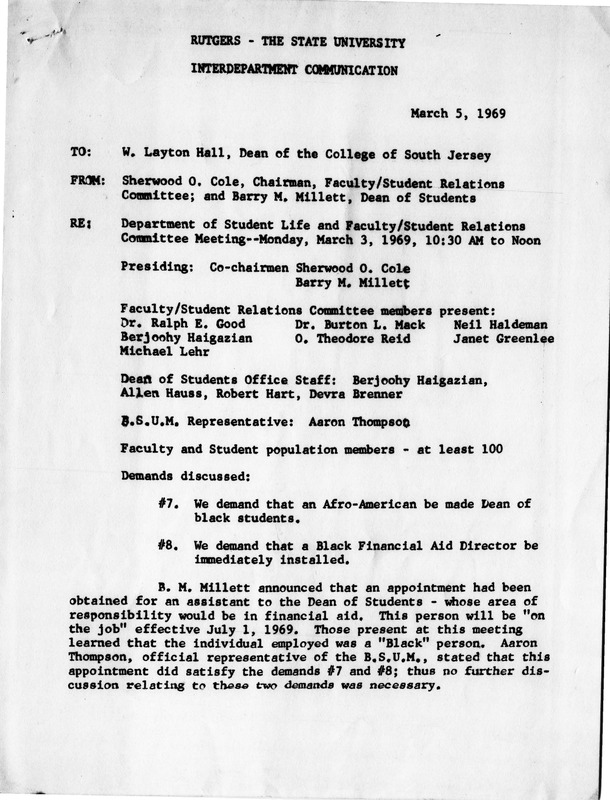
Memo from Sherwood O. Cole, Chairman of the Faculty/Student Relations Committee, and Barry M. Millett, Dean of Students, to W. Layton Hall, Dean of the College of South Jersey (Rutgers-Camden), issued on March 5, 1969. Cole and Millett report about a meeting related to the Black Student Unity Movement's demands that took place on March 3, 1969. Student Aaron Thompson represented BSUM at the meeting. BSUM demands number 7, 8, 9, and 16 were discussed.
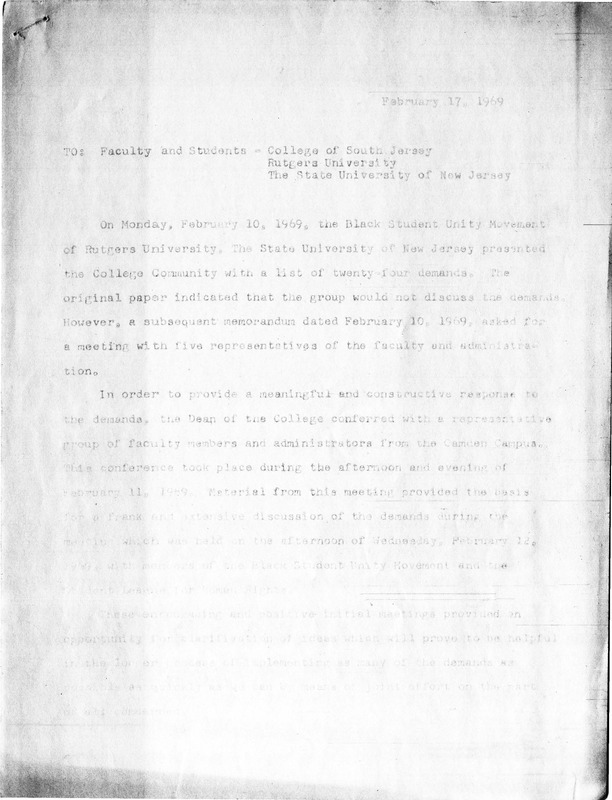
Copy of memo to Faculty and Students at the College of South Jersey (Rutgers-Camden), issued on February 17, 1969, regarding the Black Student Unity Movement's 24 demands. Although unsigned, it appears the memo was issued by the office of W. Layton Hall, the Dean of the College of South Jersey.
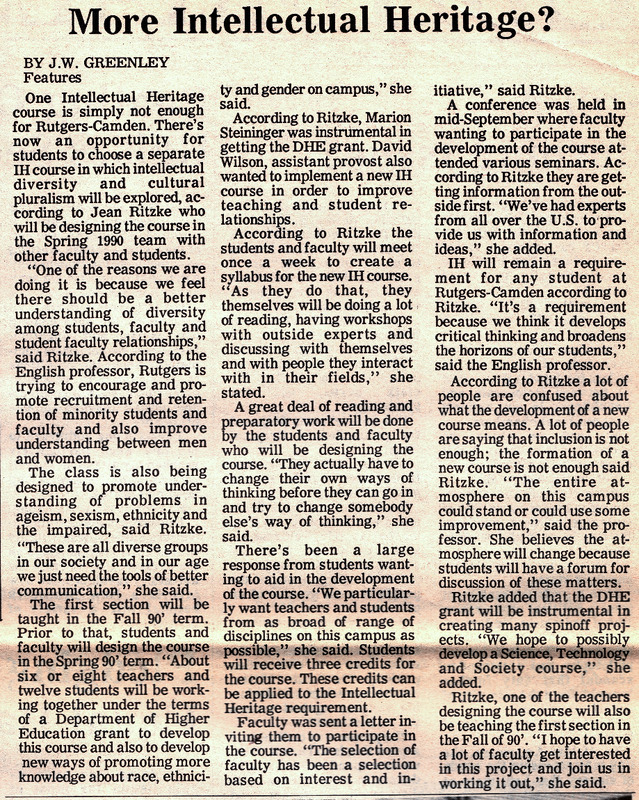
This article discusses the development of a new Intellectual Heritage (IH) course at Rutgers–Camden designed to explore intellectual diversity and cultural pluralism. Jean Ritzke, the English professor developing the course, is quoted extensively throughout the article.
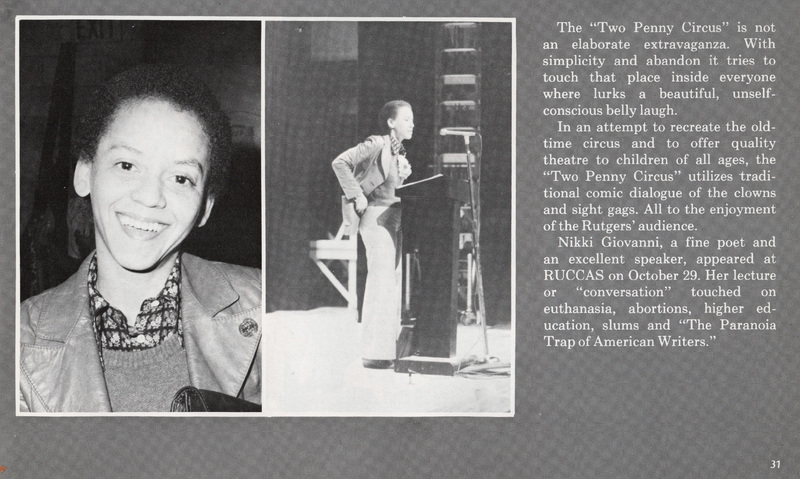
Side-by-side images of Nikki Giovanni smiling and the other where she stands at a podium giving a lecture at Rutgers-Camden. Photographs from Mneme 1976 yearbook, page 31.
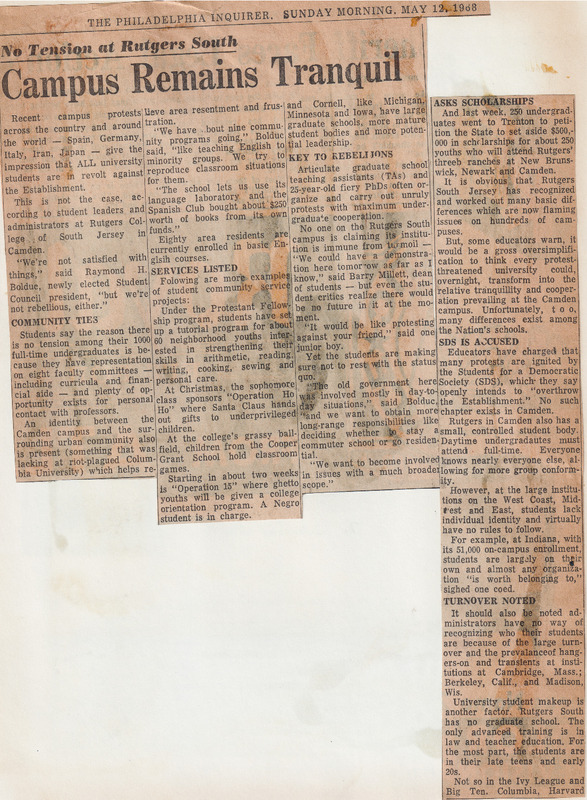
Despite protests nationwide, Camden supposedly remained protest-free, a fact that the article attributes to the close relationship between the campus and its city. The students aren't complacent, though, being involved in local programs and improving the campus through other measures.
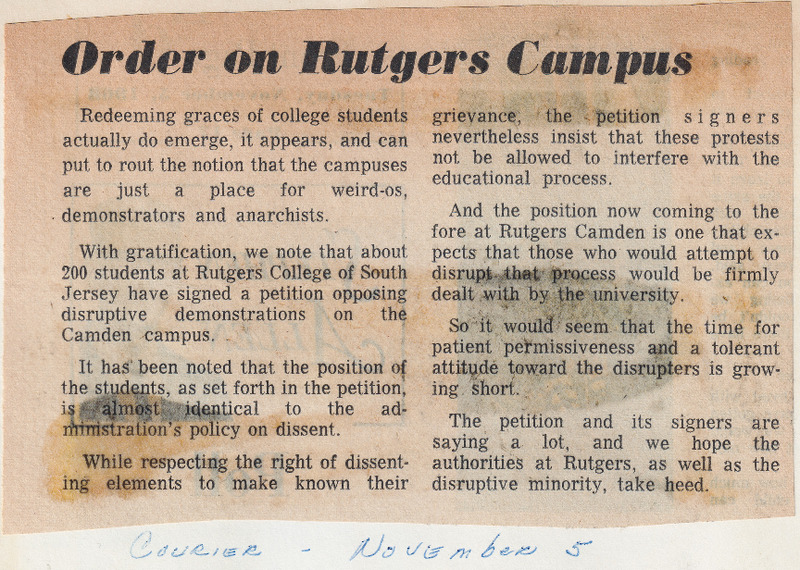
A group of 200 Rutgers students has signed a petition opposing "disruptive demonstrations" on campus. The author of the piece is pleased by this development, not wanting Rutgers to become a campus full of "weird-os, demonstrators, and anarchists" like other colleges.
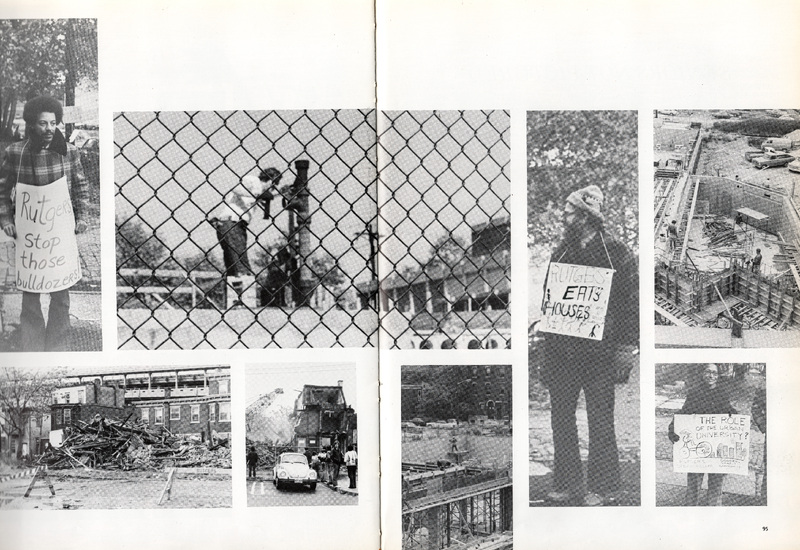
Photo (full spread) collage of debris and rubble from demolished buildings along with construction machines, such as cranes and excavators, as well as people holding up signs protesting Rutgers University's expansion by destroying houses in the Cooper-Grant neighborhood.
Protesters hold up signs:
"Rutgers stop those bulldozers!"
"Rutgers eats houses"
"The Role of the Urban University? Rutgers Steamroller / Cooper-Grant Community"
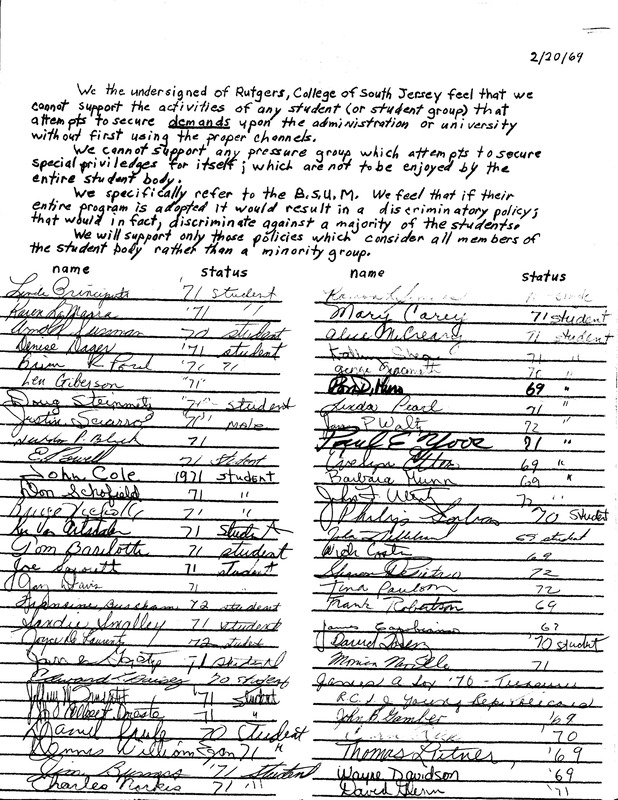
Copy of a petition with approximately 150 signatures of Rutgers-Camden students opposing the activities and demands of the Black Student Unity Movement (BSUM).
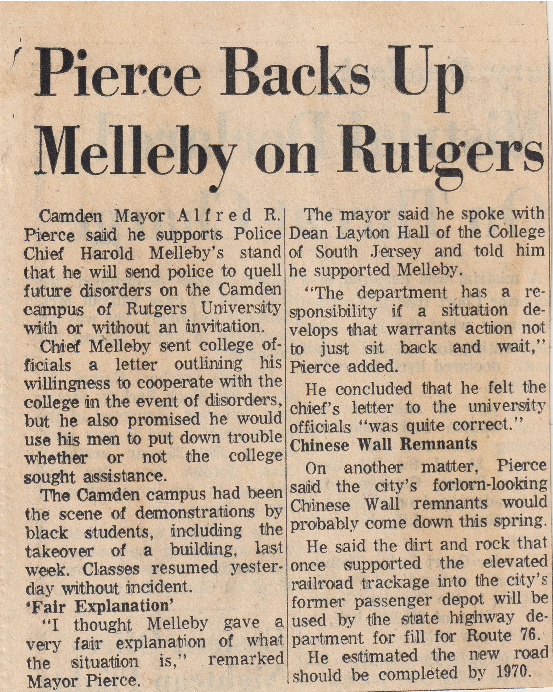
Alfred R. Pierce, the mayor of Camden, supported the chief of police in his decision to send police officers to Rutgers Camden when any protests occurred, regardless of whether or not the school invited them. This decision comes on the wings of a Black student takeover of one of the buildings the week previous.
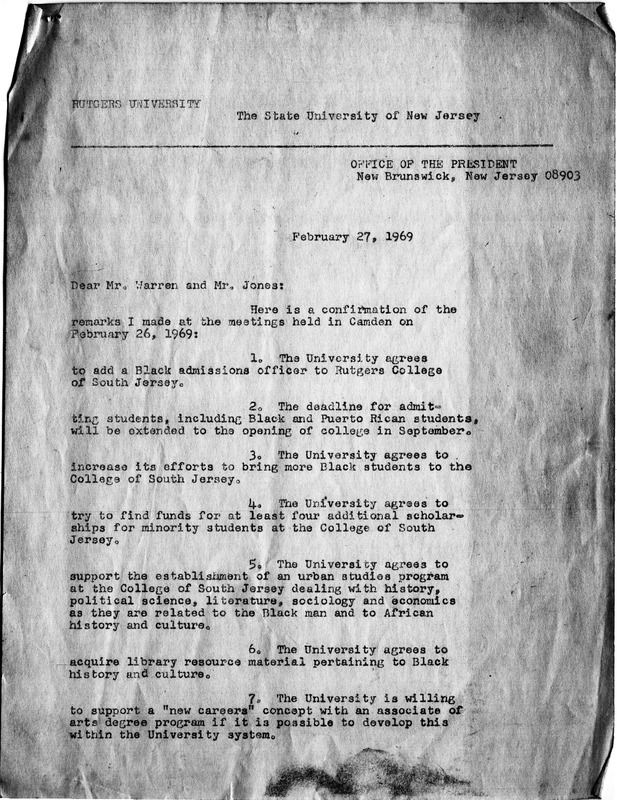
Letter from Rutgers President Mason W. Gross, dated February 27, 1969, to Rutgers–Camden students Thomas Warren and Roy Jones. The letter serves as a confirmation of the remarks that the president made at the meeting in Camden on February 26, 1969, regarding the Black Student Unity Movement's demands.
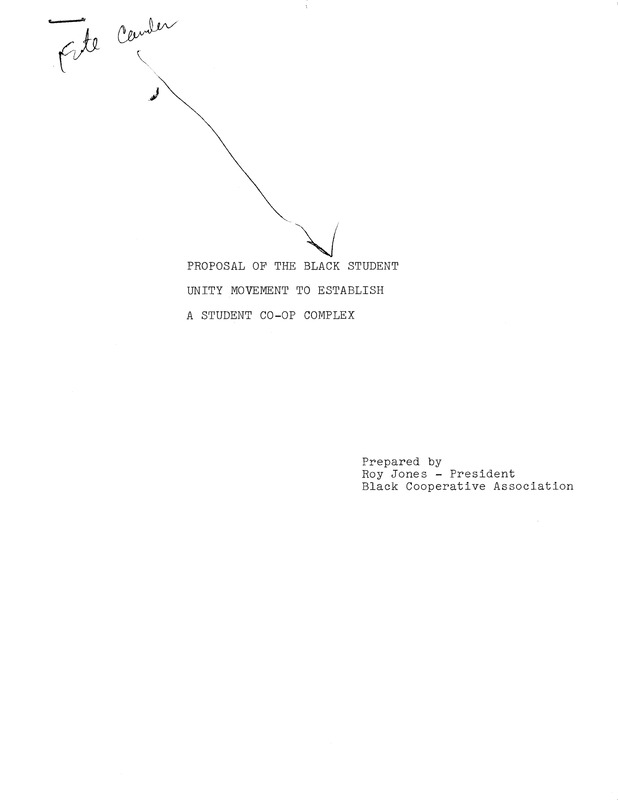
Prepared by Roy Jones, President of the Black Cooperative Association and member of the Black Student Unity Movement, this proposal outlines a plan to establish a student cooperative complex at Rutgers-Camden. The document includes information about the history and philosophy of the Black Cooperative Association, which was formed on March 20, 1969. The proposal explains that the Black Cooperative Association has already purchased a house at 301 N. 2nd St. and plans to purchase the adjacent property at 303 N. 2nd St. The proposal requests financial support from the university in the form of a loan to cover the purchase price of the second house and renovation costs.
The houses mentioned were located at the northwest corner of N. 2nd St. and Penn St., and they have since then been demolished.
The exact date of the proposal is not listed on the document, but its content suggests that it was written during the fall semester of 1969, because it refers to March 1969 as occurring "last semester."
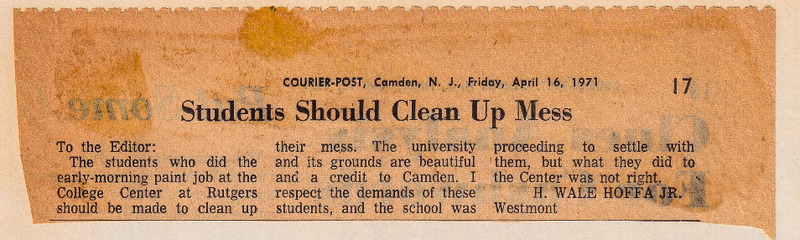
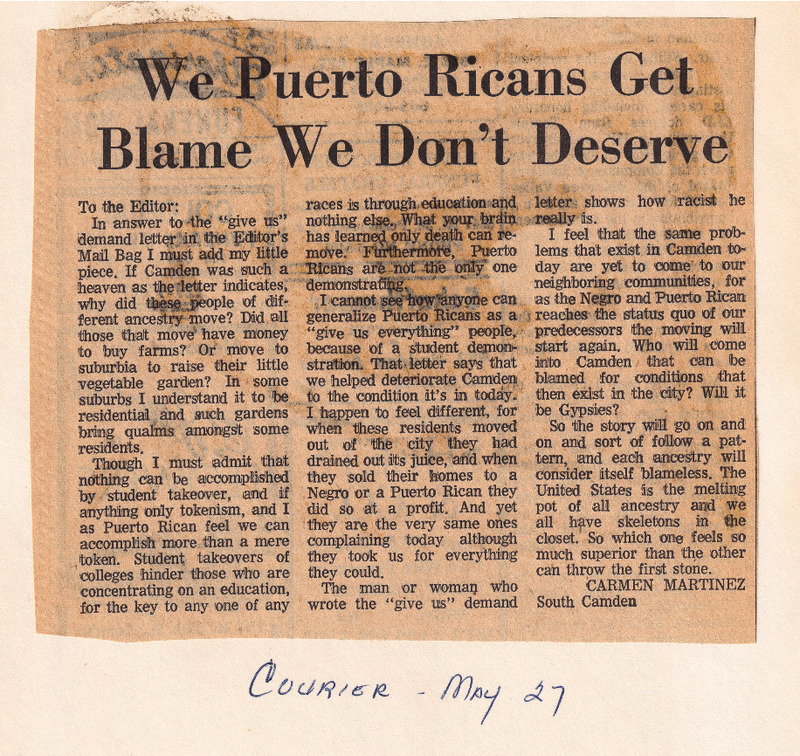
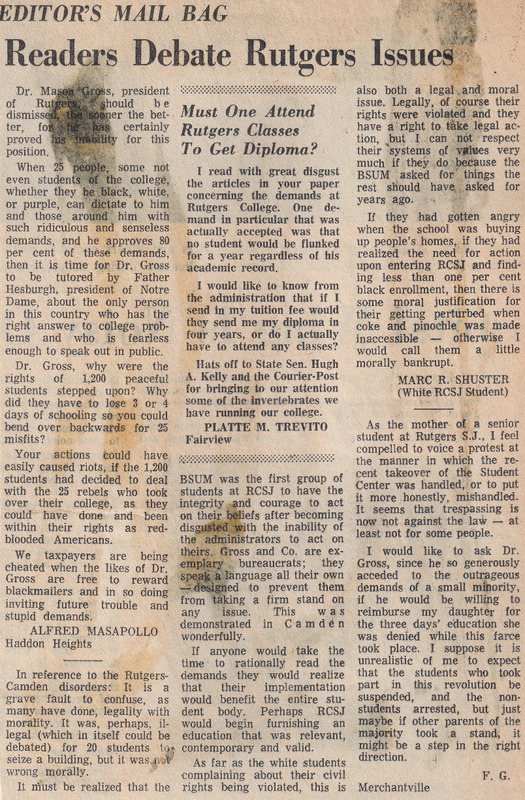
Courier-Post readers write in about the Rutgers sit-in, with three writing against its demands and one for them. One writes that she expects her daughter to be reimbursed for the three days of class she missed while the university was shut down, and another writes that those who are morally outraged about the protests should also have been outraged when Rutgers bought up people's houses to use as campus areas.
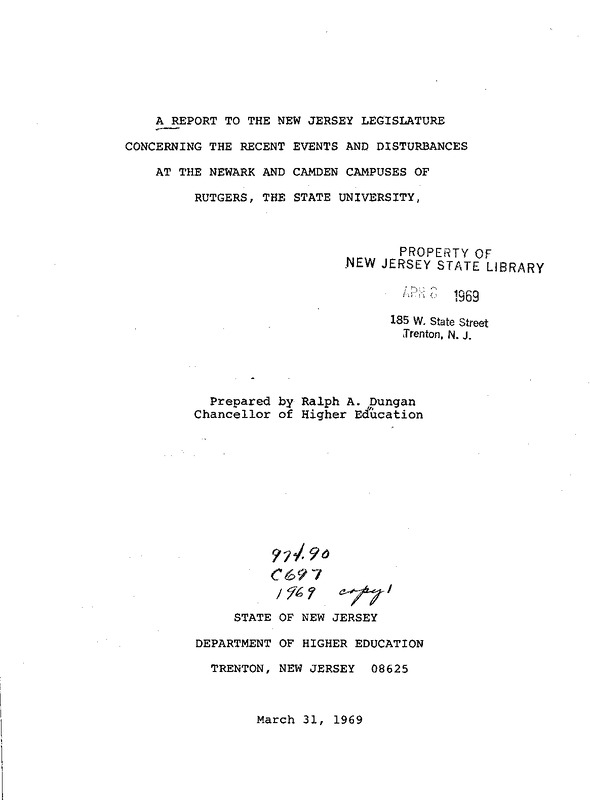
A report to the New Jersey Legislature prepared by Ralph A. Dungan, Chancellor of Higher Education, concerning the Black students' protests at Rutgers-Newark and Rutgers-Camden in February of 1969. The report includes a chronology of the events at Newark and Camden and a list of recommendations. Nine appendices are attached, including a list of demands from the Black Organization of Students at Rutgers-Newark, a list of demands from the Black Student Unity Movement at Rutgers-Camden, a resolution adopted by the Rutgers Board of Governors on March 14, 1969, and other memos related to the protests.
Author takes a hardline stance against the actions of Black students who protested the selection of an all-white administran for the Urban University Division by damaging parts of the library.
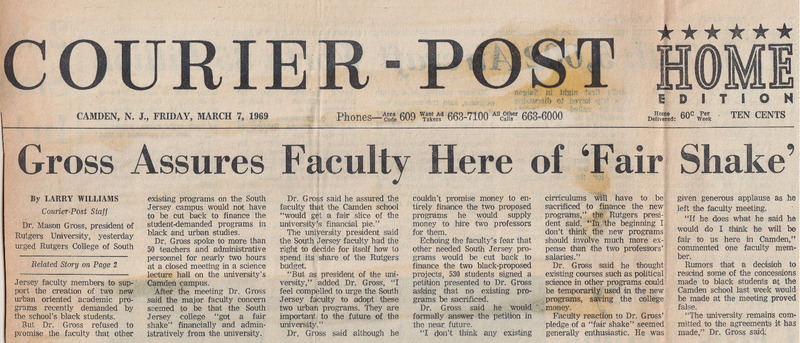
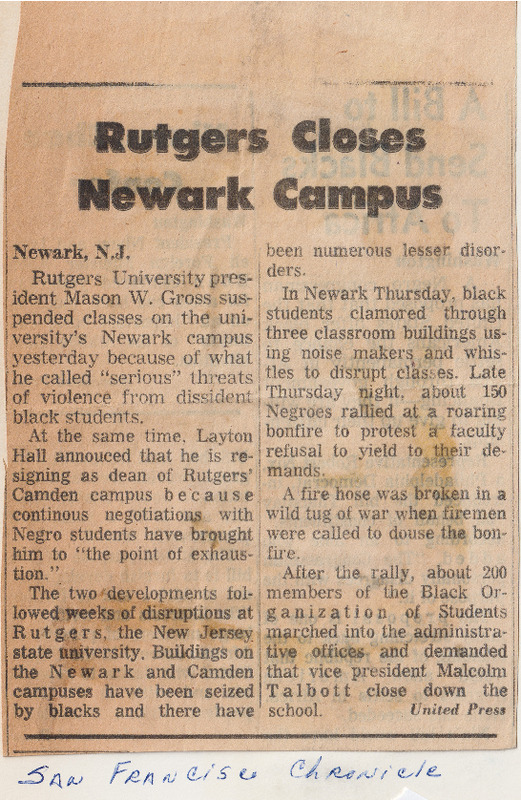
Both the Newark and Camden campuses have been closed because of Black students protesting against the administration. This is said to be the cause of Layton Hall, the former dean, retiring.
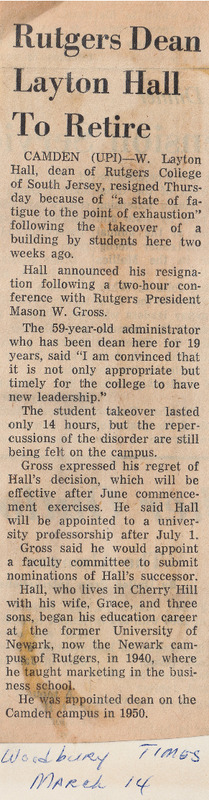
Layton Hall, former dean, retires after student protests have fatigued him "to the point of exhaustion." The university president expressed his regret, coming after a 14-hour campus takeover which has apparently left a big impact on the campus atmosphere.
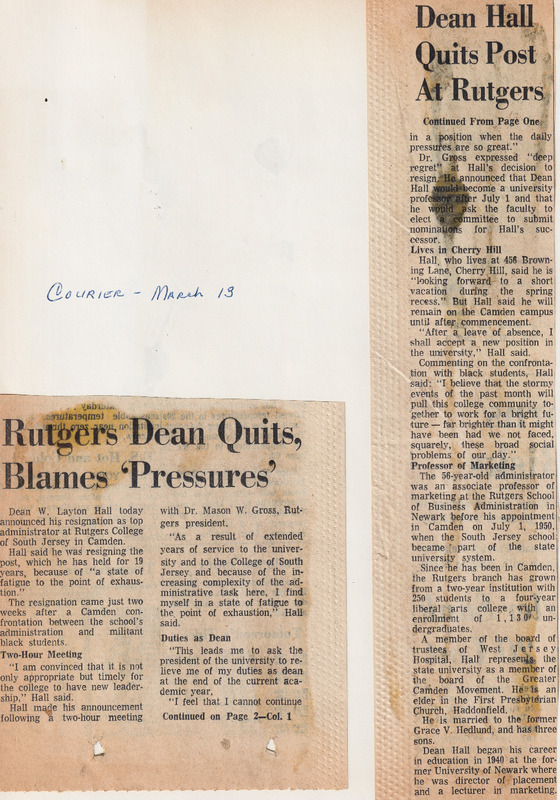
Dean W. Layton Hall is resigning from his post, stating that he cannot carry out his duties as dean any longer because of exhaustion. The article goes on to discuss his past and his positions before being Dean.
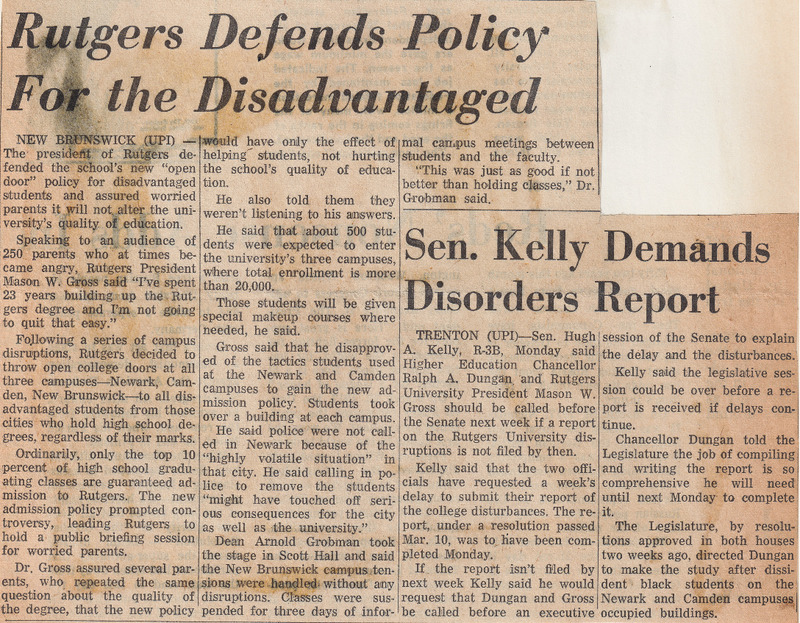
Dr. Gross defended his position of opening Rutgers to any disadvantaged students with a high school diploma in front of a meeting of angry parents, stating that it would only add 500 new students to a total student body of 20,000. He also discussed the sit-in and why the police were not called.
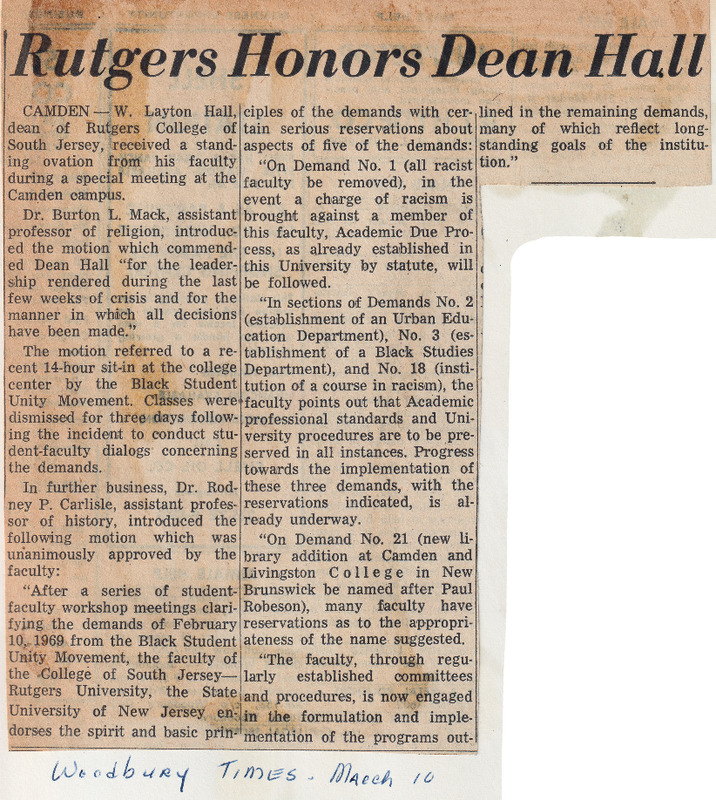
In the aftermath of the sit-in, Dean Hall was honored during a faculty meeting, during which the demands of the Black students were discussed. Three were partly approved and already underway, one was claimed to already be under academic due process, and one (the renaming of the library to Paul Robeson Library) was partially rejected due to "reservations" from the faculty.
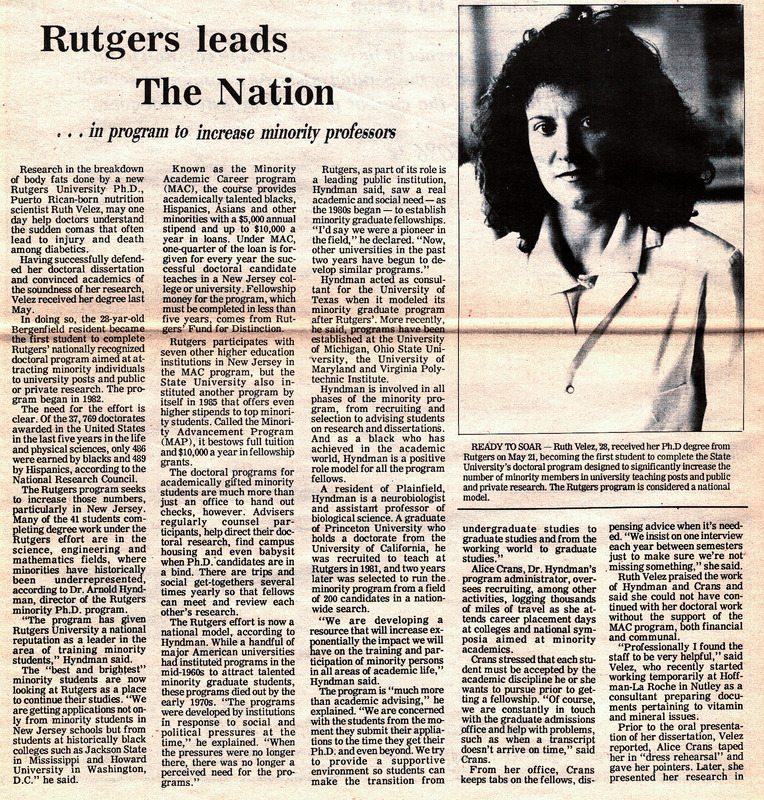
Article about the Minority Academic Career program (MAC) at Rutgers and Rutgers University's nationally recognized push to increase diversity among doctoral candidates.
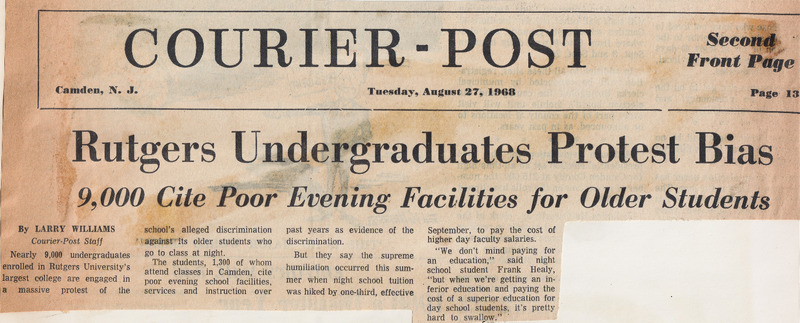
Members of the evening school have started protesting because of a tuition raise that would not be used for its stated purpose (a wage hike for staff that would not be implemented until 1971). Students say that they will stay peaceful for now, but will continue protesting if not listened to, and are looking to form a student council.
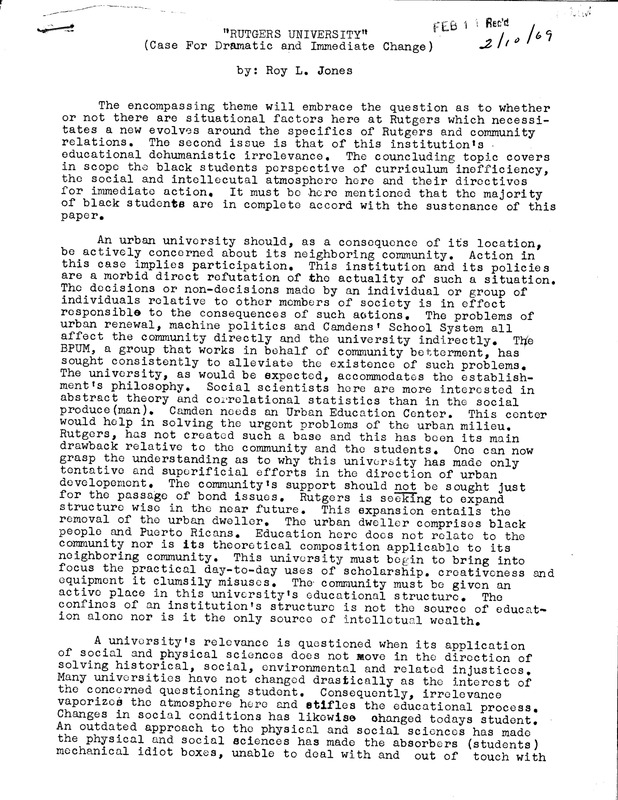
In this essay, Roy L. Jones discusses the relationship between the Rutgers University and the surrounding community in Camden, which is predominantly Black and Puerto Rican. Jones makes the case that, as an urban university, Rutgers should reconsider its impact, structure, and responsibility to the Camden community, as well as to the Black and Puerto Rican student populations.
Following Jones's essay, the document concludes with an evocative piece of writing by Myrna Williams, titled "Black Feeling," which addresses the alienation Williams feels as a Black student on campus.
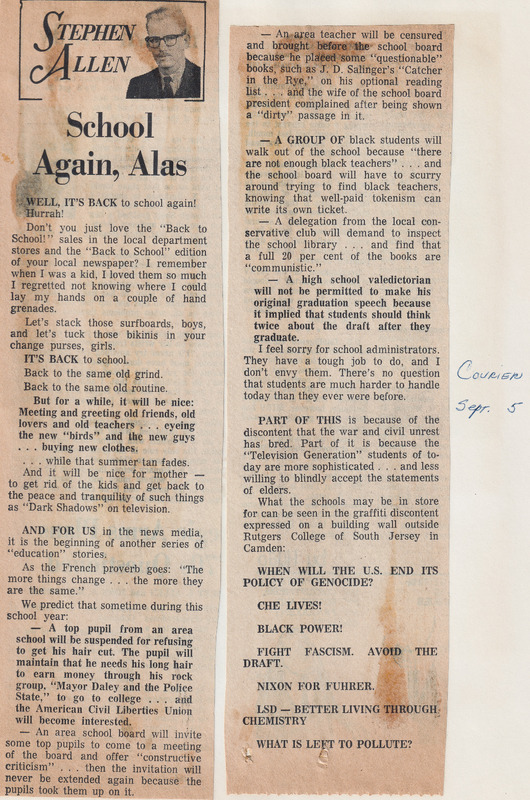
Stephen Allen writes a sarcastic column piece about back-to-school season, discussing "predictions" of the school year which includes library censorship for communism, Black students protesting for a lack of Black teachers, and school boards rejecting student criticism.
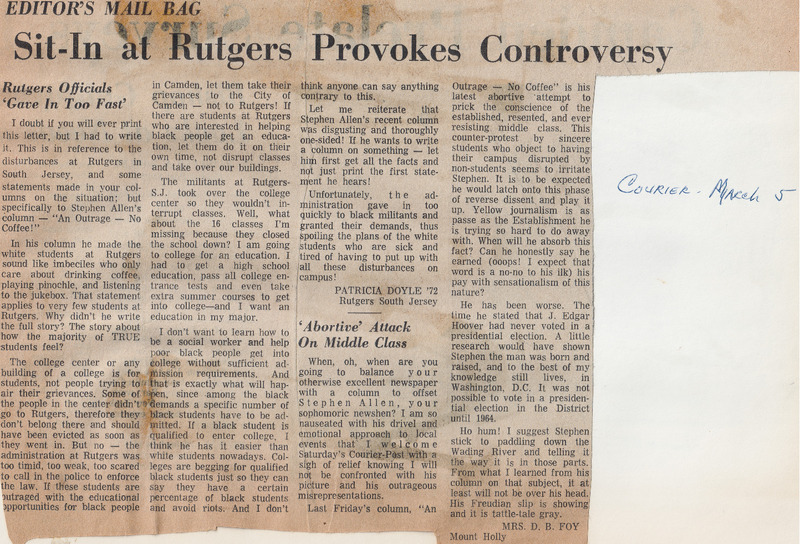
Two letters to the Courier-Post write in opposition to a previous Stephen Allen column about the sit-in. They argue that Rutgers was too weak against the Black student protests, stating that they were there to get an education in their chosen field, not to "help poor black people get into college without sufficient admission requirements."
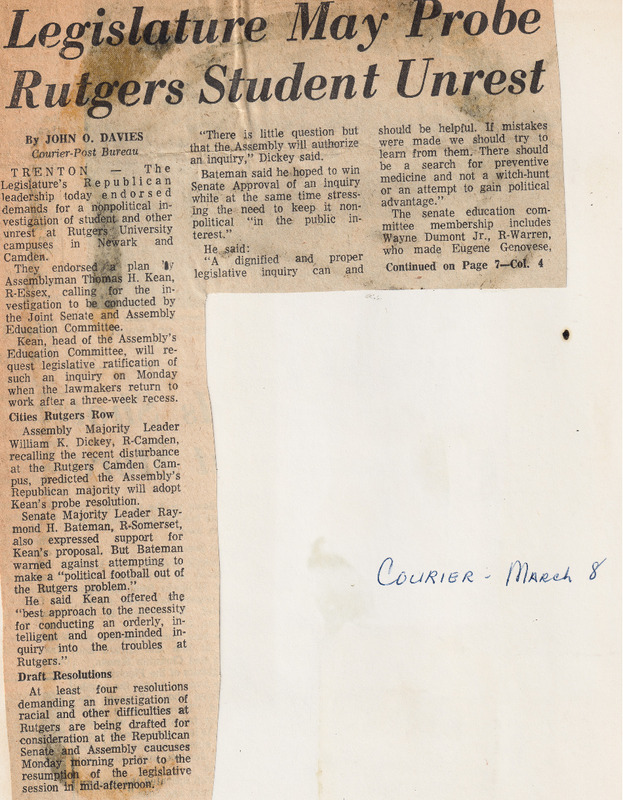
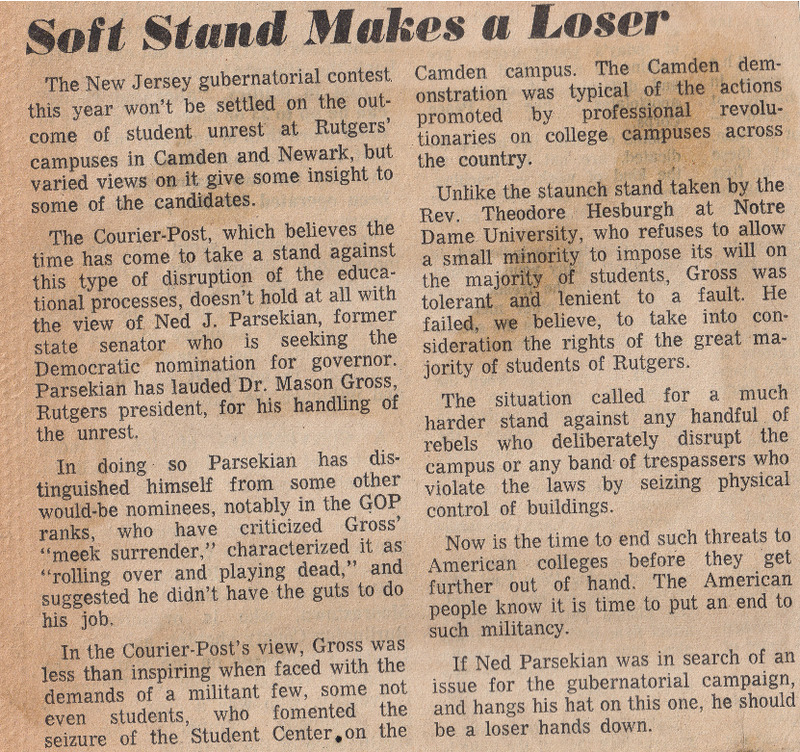
The Courier-Post reports on the candidates for governor, who commented on the recent unrest at Rutgers Camden. The Post states that Gross was too "soft" on the students, and failed to take into account the "rights of the great majority of students at Rutgers."
The author supports the Black student sit-ins and states that supporting their cause, and being berated and spit on by her fellow students, made her far more supportive of militant action against racist institutions. She says that she and some of her fellow white students support them and hopes that others will soon join them.
A complete four-disc 78rpm album set titled "Songs of Free Men," performed by baritone Paul Robeson with Lawrence Brown at the piano. Robeson sings in English, Russian, German, and Spanish. Released in 1943 by Columbia Masterworks (Set M-534), the tri-color (white, red, and black) sleeve features cover art by Alex Steinweiss: a hand with a broken shackle plunging a knife into a wormlike creature bearing a swastika emblem.
The interior of the sleeve contains a white page with black text providing context for the collection as a call against the destruction of fascism and for the liberation of peoples. This section features a portrait of Paul Robeson with a printed autograph and a statement from the artist:
"As one brought up on the songs of their own people, who expressed in them their sorrows, protests and hopes, I early felt closer to that music which comes directly from folk roots. The particular songs in this album have that folk quality and show in no uncertain way the common humanity of man. Beyond this, they issue from the present common struggle for a decent world, a struggle in which the artist must also play his part."
This specific copy includes hand-drawn markings on the Robeson portrait and on some of the disk labels.
Each black phonograph record features a blue and gold Columbia Masterworks label. Labels provide information about supporting musical sections and groups for certain tracks.
The back of the album is a solid red sleeve. The interior of the back sleeve features promotional information from the Columbia Recording Corporation, including their logo and office locations in New York, Hollywood, and Bridgeport.
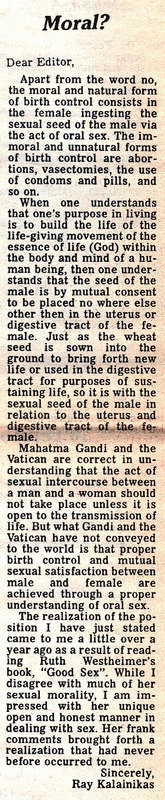
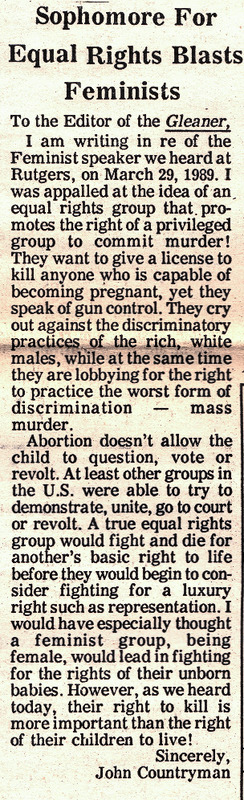
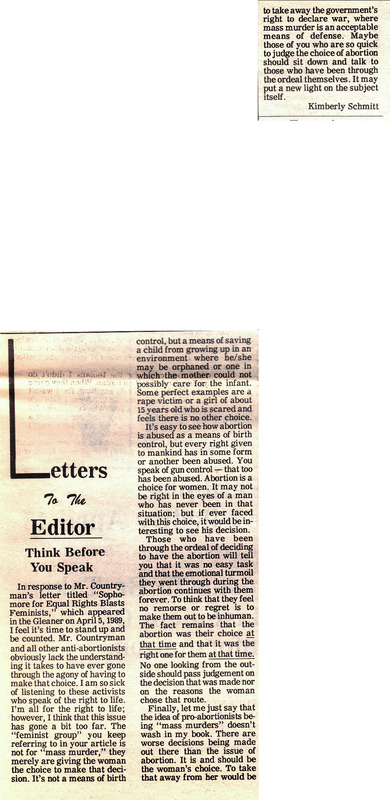
In this letter to the editor, John Countryman strongly criticizes a feminist speaker who visited campus and rebukes the pro-choice arguments of feminist groups.
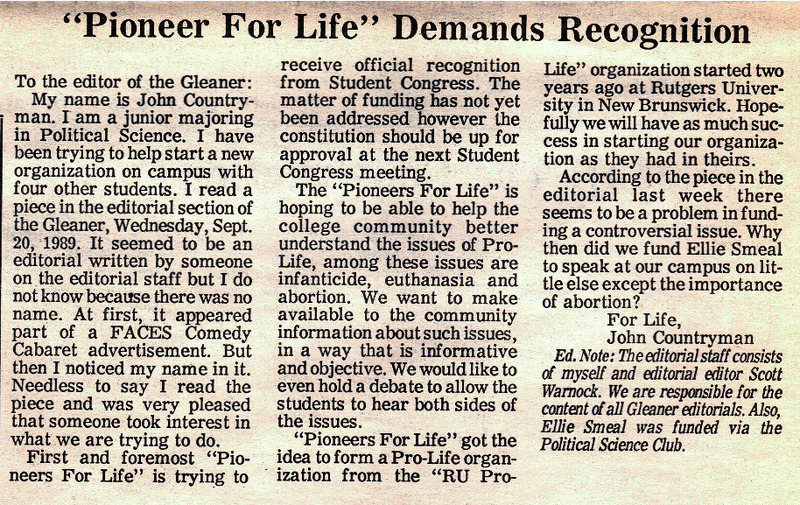
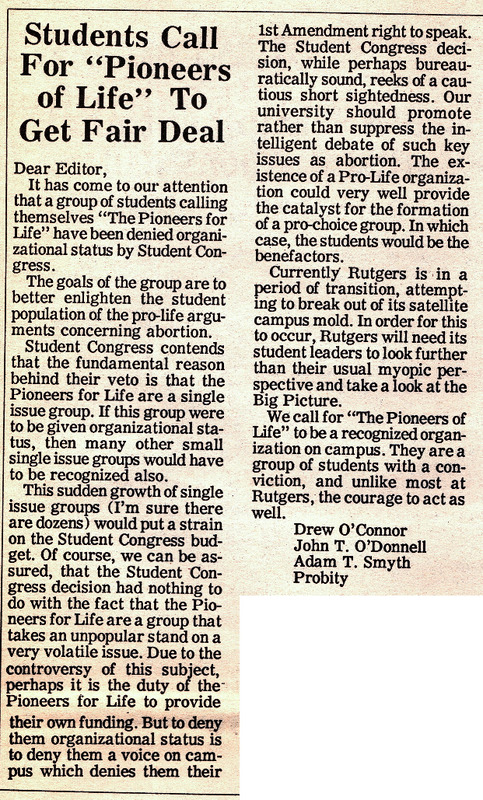
This is a "Letter to Editor" in which a group of students argue that a pro-life student group deserves organizational status from the Student Congress. They argue that university should promote discussions on abortion.
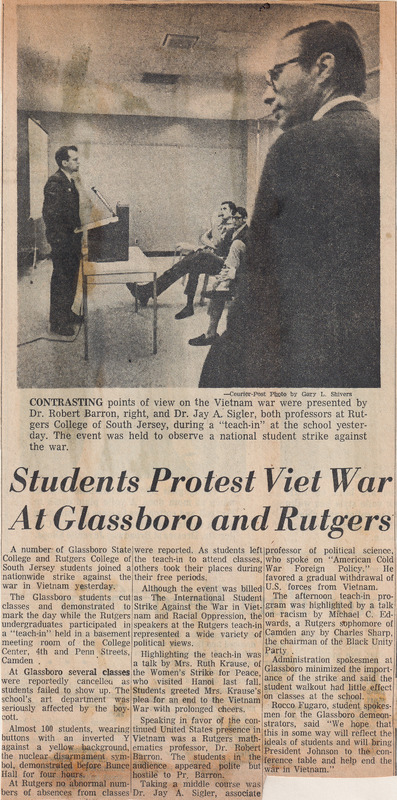
Students at both Glassboro State College and Rutgers Camden participated in protests and a day-long teach-in, with students joining whenever they had a free period. Both administrations downplayed the protests' significance.
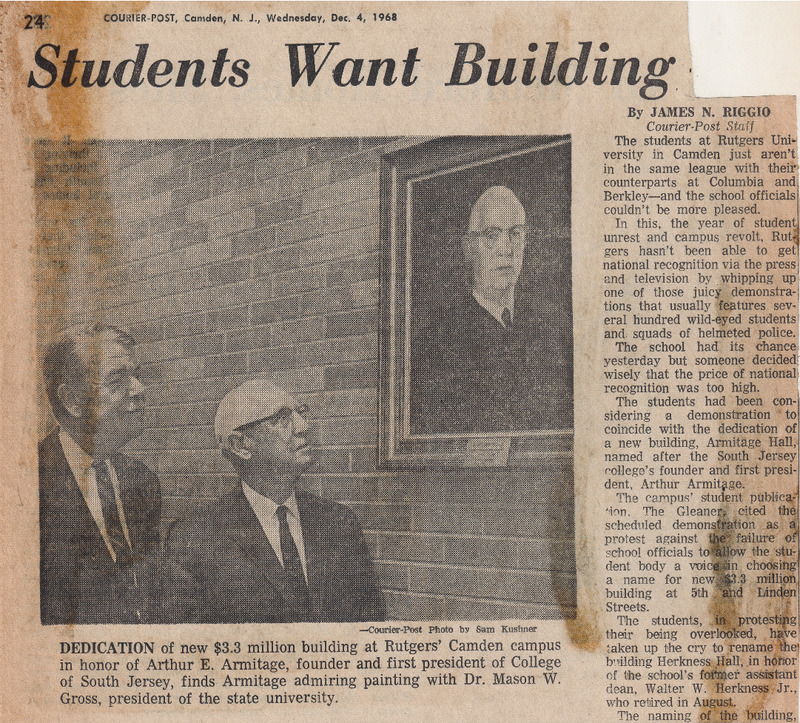
The students of Rutgers protested in small ways against the naming of Armitage Hall, which was named without any input from the student body. Students didn't march, but they made their desire for a different name, Herkness Hall, known in the building and with an article in the Gleaner.
This is an advertisement for the Camden Rutgers Advanced Students in History (CRASH) Lecture series about different subjects like Afro-American history, Gay and Lesbian History, Hispanic History, and Women's history.
This letter responds to a previously published letter from Mr. Countryman about abortion. Schmitt is pro-choice and refutes Mr. Countryman's arguments.
Layton Hall, former dean, is resigning so that the college may have "new leadership." He refers to the sit-in protests at the end of the previous month, after which the university conceded to 18 of the 24 student demands.
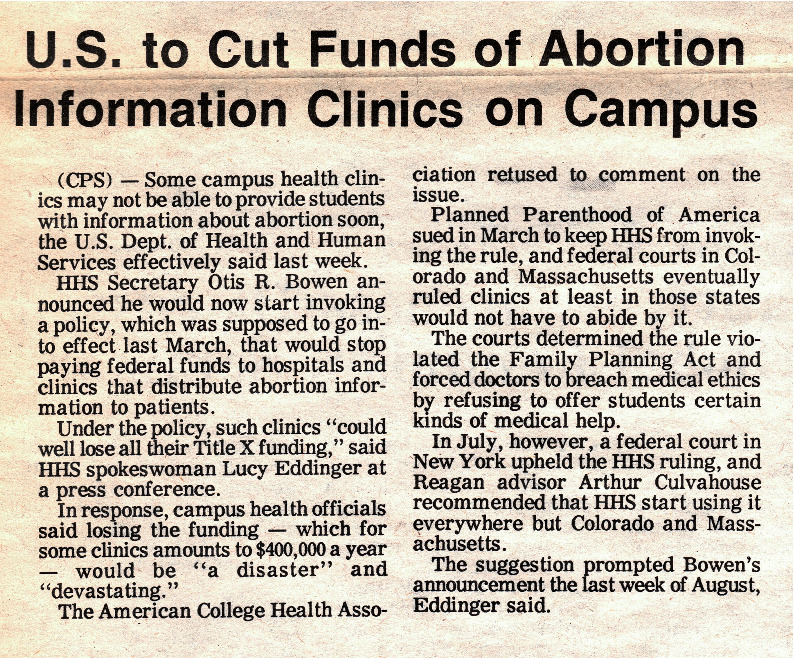
Article about how the U.S. Department of Health and Human Services plans to cut federal funding for medical clinics that provide abortion information to patients. The decision was challenged by Planned Parenthood in court but a federal court ruled in favor of the Department. Created by College Press Service (CPS) and syndicated to the Gleaner.
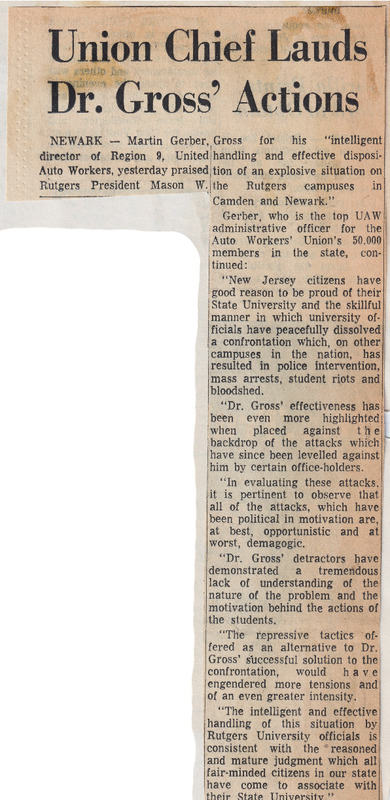
A union chief praises Dr. Gross, the president of Rutgers, for how he handled the student protests. In other states, this has led to police violence and bloodshed, and he handled it well despite "the attacks which have since been levelled against him by certain office-holders".
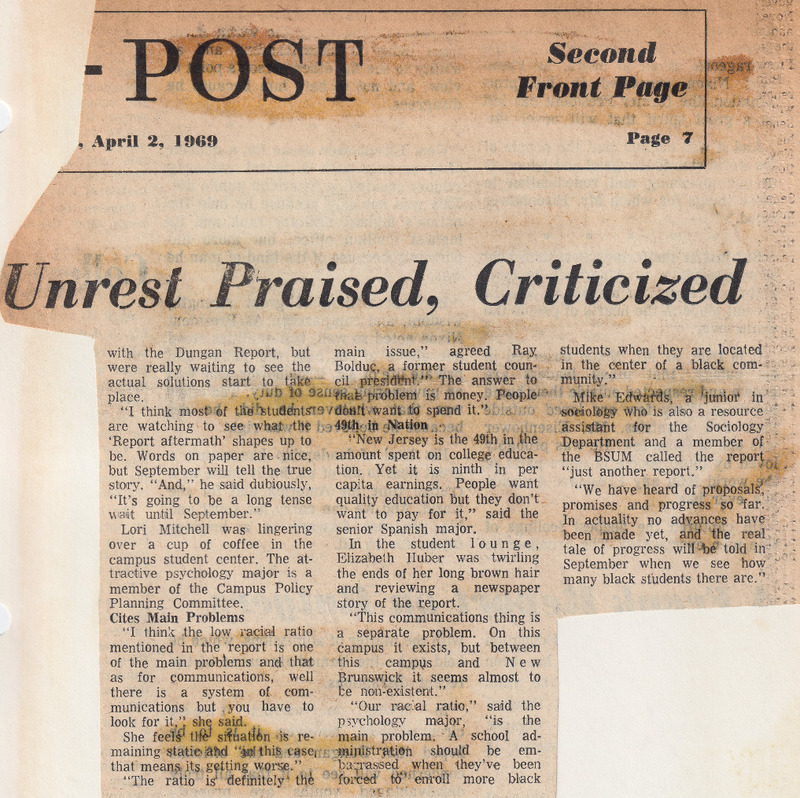
The article discusses the incoming Dungan Report on the Rutgers situation, and interviews a few students, who all seem to agree that the real issue at hand is lack of spending on education and Rutgers not admitting enough Black students despite being located in a majority Black community.